

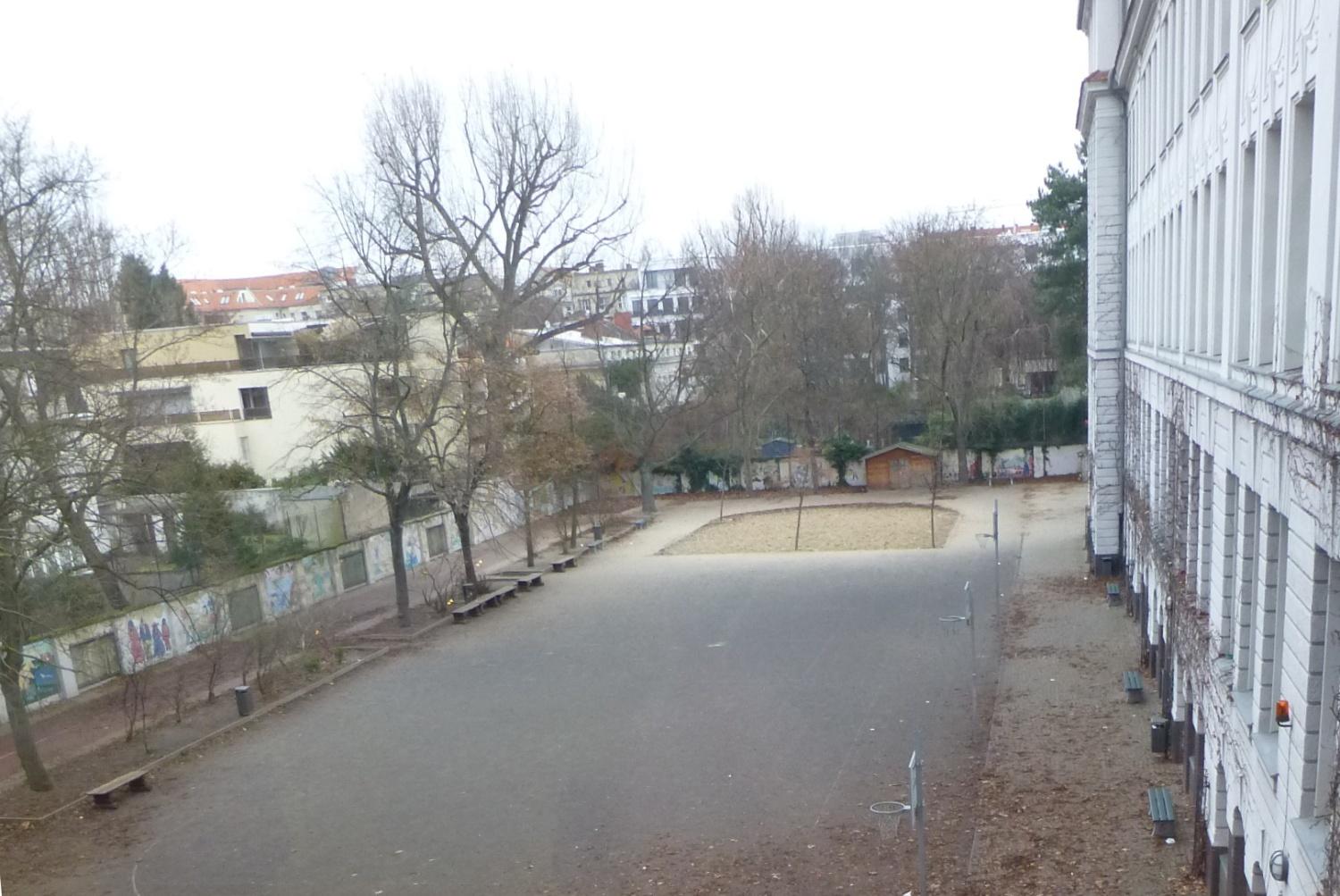
‘Grün macht Schule’ has been informing, advising, and supporting schools and school initiatives in Berlin since 1983 in the planning and realization of schoolyard projects. The program focuses on improving school playgrounds by creating child-friendly, natural habitats and ecological learning spaces, making schoolyards better equipped to address climate change. In 2012, the program expanded with the launch of the ‘Grün macht Schule - KinderGARTEN’ funding initiative, which extended support to kindergartens. Over the past four decades, with the program’s assistance, Berlin has seen the transformation of large, unstructured schoolyards into smaller, creative playgrounds. These spaces now feature imaginative and artistic objects alongside facilities for play, exercise, and communication. Additionally, many school gardens and biotopes have been established or restored, turning school grounds into vibrant ecological and educational environments . The projects are largely driven by schools’ self-initiatives, with ‘Grün macht Schule’ offering support throughout. This grassroots approach fosters pride and a sense of ownership among school communities, strengthening their identification with the results. The collaborative effort also enriches educational practices, promoting inclusion, integration, and democratic participation. Such initiatives offer a hands-on experience with sustainable climate protection projects, making these efforts tangible and impactful in everyday school life. In addition to its project-based support, ‘Grün macht Schule’ provides training for school teams, organizes regional and national conferences, and hosts seminars and lectures to share best practices and inspire further action . The program is a cooperative effort between the Senate Department for Education, Youth and Family and the association Freilandlabor Britz e.V., operating under the guidance of the Senate Department. (Ref. 1-4, 6)

Overview
Nature-based solution
- Grey infrastructure featuring greens
- Green playgrounds and school grounds
Key challenges
- Climate action for adaptation, resilience and mitigation (SDG 13)
- Climate change adaptation
- Climate change mitigation
- Environmental quality
- Air quality improvement
- Soil quality improvement
- Green space, habitats and biodiversity (SDG 15)
- Green space creation and/or management
- Habitat and biodiversity restoration
- Regeneration, land-use and urban development
- Promote natural styles of landscape design for urban development
- Water management (SDG 6)
- Stormwater and rainfall management and storage
- Health and well-being (SDG 3)
- Enabling opportunities for physical activity
- Inclusive and effective governance (SDG 16)
- Inclusive governance
- Social justice, cohesion and equity (SDG 10)
- Environmental education
- Sense of community and community engagement
Principal problems in Functional Urban Area (FUA)
- Climate-Related Hazards
- Urban flooding (stormwater)
- Heat stress & Extreme temperatures
- Environmental Degradation
- Biodiversity loss
- Air pollution
- Health, Well-being and Social cohesion
- Inadequate access to recreational opportunities
- Disconnection from nature
- Poor community engagement
Key priorities
Focus
Project objectives
Implementation activities
Climate-focused activities
Climate change adaptation:
- Increase urban vegetation cover to reduce urban heat island effect
- Implement sustainable urban drainage schemes to manage stormwater
Climate change mitigation:
- Increase the availability of green urban space for carbon storage (street tree cover)
Biodiversity conservation or restoration-focused activities
Biodiversity restoration:
- Rehabilitate and restore damaged or destroyed ecosystems
- Restore species (native, endangered, or unspecified)
- Restore native species
- Restore ecological connectivity
- Public engagement
Main beneficiaries
- Young people and children
Governance
Management set-up
- Co-governance with government and non-government actors
Type of initiating organisation
- Regional government
- Public sector institution
- Non-government organisation/civil society
Participatory approaches/ community involvement
- Co-planning (e.g. stakeholder workshops, focus groups, participatory mapping)
- Deliberative decision-making processes (e.g., consensus building, deliberative polling)
- Dissemination of information and education
- Joint implementation (e.g. tree planting)
- Co-management/Joint management
Details on the roles of the organisations involved in the project
Project implemented in response to ...
Type of enablers
Financing
Total cost
Source(s) of funding
- Public regional budget
- Corporate investment
- Private Foundation/Trust
Type of funding
- Earmarked public budget
- Direct funding (grants, subsidies, or self-financed projects by private entities)
- Donations
Non-financial contribution
- Provision of land
- Provision of goods
- Provision of labour
- Provision of expertise
- Public authorities (e.g. land, utility services)
- Citizens (e.g. volunteering)
- Private sector (businesses, financial institution)
Impacts and Monitoring
Environmental impacts
- Climate change
- Lowered local temperature
- Expected lowered local temperature
- Enhanced carbon sequestration
- Expected enhanced carbon sequestration
- Environmental quality
- Improved air quality
- Expected improved air quality
- Improved soil quality
- Expected improved soil quality
- Water management and blue areas
- Improved stormwater management
- Expected improved stormwater management
- Green space and habitat
- Increased green space area
- Achieved increased green space area
- Reduced biodiversity loss
- Achieved reduced biodiversity loss
Economic impacts
- Unknown
Socio-cultural impacts
- Health and wellbeing
- Enhanced cognitive restoration, relaxation and stress relief
- Achieved enhanced cognitive restoration, relaxation and stress relief
- Cultural heritage and sense of place
- Increased sense of place identity, memory and belonging
- Achieved increased sense of place identity, memory and belonging
- Safety
- Increased perception of safety
- Achieved increased perception of safety
Type of reported impacts
Presence of formal monitoring system
Presence of indicators used in reporting
Presence of monitoring/ evaluation reports
Availability of a web-based monitoring tool
Potential risks of implementation and trade-offs
References




 Information about this nature-based solution was collected as part of the Naturescapes project funded by the European Union under Grant Agreement No 101084341.