

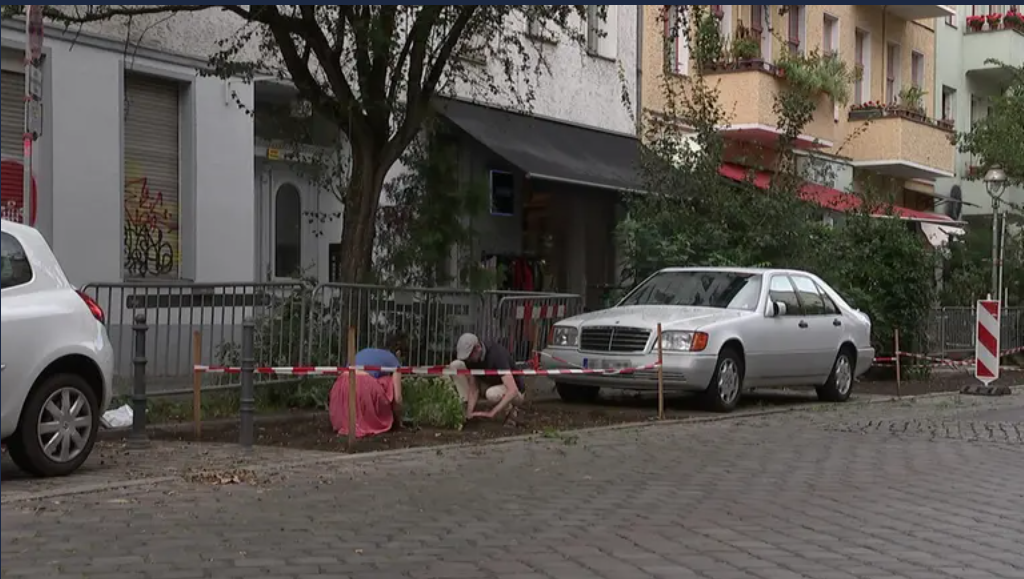
Since the 1980s, the Graefekiez neighborhood in Berlin's Friedrichshain-Kreuzberg district has been a traffic-calmed area where all road users are treated equally, driving is limited to walking speed, and cars are permitted to stop anywhere. However, this once-progressive concept no longer functions effectively due to the significant increase in cars and delivery vehicles over the years. The streets no longer resemble a traffic-calmed zone, with traditional layouts featuring roadways, sidewalks, and parking spaces. As a result, many users fail to recognize the traffic-calmed nature of the area, leading to safety issues: vehicles drive too fast, delivery traffic causes conflicts, and streets are difficult to navigate safely. Berlin’s transport sector faces the challenge of meeting legally mandated CO₂ reduction targets. Achieving these goals requires bold measures, including limiting private motorized transport (MIV), especially in densely populated areas where residents and visitors have access to alternative modes of transportation. The "Graefekiez" project addresses these challenges through urban redevelopment aimed at improving livability and promoting sustainable urban mobility. Car parking has been banned from the streets, freeing up space for communal use such as lounge areas. As part of the "Graefekiez" project, the district office is converting parking spaces into green spaces and expanding tree disks to adapt to the climate and promote a sponge city. The project was developed collaboratively with residents and NGOs through a participatory process led by the Friedrichshain-Kreuzberg district office, in partnership with the Berlin Social Science Center and Paper Planes e.V. Implementation began in 2023 on Graefestraße and Bockhstraße.After a six-month trial period, the district office decided in 2024 to make the measures permanent. This initiative advances a safer, greener, inclusive urban environment while meeting climate and community goals. (Ref. 1, 2, 3)

Overview
Nature-based solution
- Green areas for water management
- Sustainable urban drainage systems
- Other
- Grey infrastructure featuring greens
- Alley or street trees and other street vegetation
Key challenges
- Climate action for adaptation, resilience and mitigation (SDG 13)
- Climate change adaptation
- Climate change mitigation
- Green space, habitats and biodiversity (SDG 15)
- Green space creation and/or management
- Regeneration, land-use and urban development
- Regulation of built environment
- Water management (SDG 6)
- Stormwater and rainfall management and storage
- Inclusive and effective governance (SDG 16)
- Inclusive governance
- Social justice, cohesion and equity (SDG 10)
- Social justice and equity
Principal problems in Functional Urban Area (FUA)
- Climate-Related Hazards
- Urban flooding (stormwater)
- Land use and Socio-economic change
- Rapid urbanization
- Other
Key priorities
Focus
Project objectives
Implementation activities
Climate-focused activities
Climate change adaptation:
- Implement sustainable urban drainage schemes to manage stormwater
- Other
Climate change mitigation:
- Other
Main beneficiaries
- Citizens or community groups
Governance
Management set-up
- Government-led
Type of initiating organisation
- Local government/municipality
Participatory approaches/ community involvement
- Co-planning (e.g. stakeholder workshops, focus groups, participatory mapping)
- Deliberative decision-making processes (e.g., consensus building, deliberative polling)
- Dissemination of information and education
- Consultation (e.g. workshop, surveys, community meetings, town halls)
- Joint implementation (e.g. tree planting)
- Co-management/Joint management
Details on the roles of the organisations involved in the project
Project implemented in response to ...
Type of enablers
Financing
Total cost
Source(s) of funding
- Public local authority budget
- Public regional budget
- Research organisation / University
Type of funding
- Earmarked public budget
- Direct funding (grants, subsidies, or self-financed projects by private entities)
Non-financial contribution
- Provision of land
- Provision of expertise
- Public authorities (e.g. land, utility services)
- Citizens (e.g. volunteering)
Impacts and Monitoring
Environmental impacts
- Climate change
- Enhanced carbon sequestration
- Expected enhanced carbon sequestration
- Water management and blue areas
- Improved stormwater management
- Expected improved stormwater management
- Green space and habitat
- Increased green space area
- Expected increased green space area
- Increased number of species present
- Expected increased number of species present
Economic impacts
- Unknown
Socio-cultural impacts
- Health and wellbeing
- Gain in activities for recreation and exercise
- Expected gain in activities for recreation and exercise
- Safety
- Increased perception of safety
- Expected increased perception of safety
Type of reported impacts
Presence of formal monitoring system
Presence of indicators used in reporting
Presence of monitoring/ evaluation reports
Availability of a web-based monitoring tool
Potential risks of implementation and trade-offs
References

 Information about this nature-based solution was collected as part of the Naturescapes project funded by the European Union under Grant Agreement No 101084341.