, Berlin (FUA), Germany
City population: 4186143
Duration: 2024 – ongoing
Implementation status: In piloting stage
Scale: Meso-scale: Regional, metropolitan and urban level
Project area: unknown
Type of area: Public Greenspace Area
Last updated: November 2024

Berlin has faced severe water shortages in recent years, with ponds, small lakes, and pools suffering significantly. Many have dried out or disappeared, causing habitats for countless animals and plants to vanish. Urbanization exacerbates the issue, as more areas become sealed, preventing rainwater from replenishing soil and water bodies. Recognizing the urgency, Berlin introduced the Eco-Account, a strategic reserve of areas and initiatives to mitigate the effects of urban development on nature and landscapes. Central to this is the Blue Pearls for Berlin program, focusing on revitalizing small water bodies to restore biodiversity and ecological balance. The project identified approximately 30 ponds, pools, lakes, and ditches from over 100 candidates to be transformed into "blue pearls." These revitalized areas will support local ecosystems and improve Berlin’s water cycle. The Berlin Rainwater Agency, alongside departments responsible for nature, climate protection, and water management, is spearheading the initiative in collaboration with the Berlin Nature Conservation Foundation. Two pilot sites—the Schleipfuhl/Feldweiher water complex in Marzahn-Hellersdorf and the Lankegrabenteich in Steglitz-Zehlendorf—were prioritized for restoration in 2024. These efforts include improving water quality and creating diverse habitats for wildlife. Enhancing small water bodies not only provides a refuge for animals and plants but also contributes to climate adaptation. Restored ponds and lakes can cool surrounding areas and improve the urban microclimate by utilizing locally accumulated rainwater. Blue Pearls for Berlin, approved by the Senate in 2022, aligns with the city’s Eco-Account framework, ensuring that these restored blue spaces offset ecological damage caused by infrastructure and urban projects. The initiative offers Berliners new ways to experience nature, fostering a balance between development and environmental preservation. (Ref. 1, 2, 4, 6, 7)

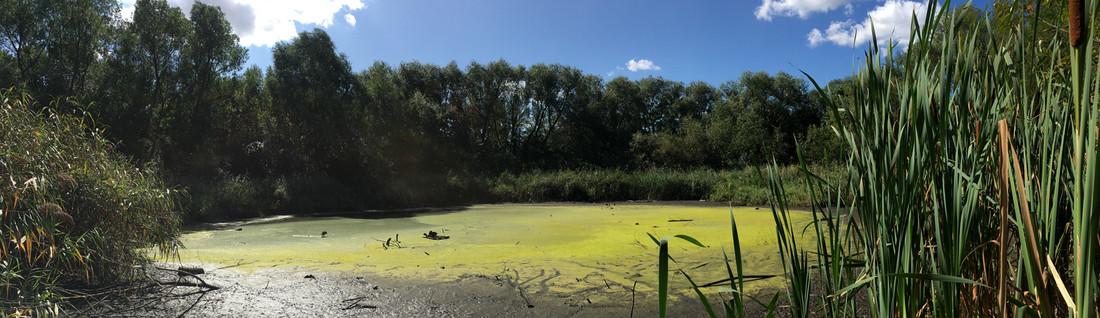
The Lankengrabenteich, one of the first piloting locations
Christo Libuda

Overview

Nature-based solution

  • Blue infrastructure
  • Lakes/ponds
  • Rivers/streams/canals/estuaries
  • Riverbank/Lakeside greens

Key challenges

  • Climate action for adaptation, resilience and mitigation (SDG 13)
  • Climate change adaptation
  • Green space, habitats and biodiversity (SDG 15)
  • Habitat and biodiversity restoration
  • Water management (SDG 6)
  • Stormwater and rainfall management and storage
  • Water security
  • Health and well-being (SDG 3)
  • Creation of opportunities for recreation

Principal problems in Functional Urban Area (FUA)

  • Climate-Related Hazards
  • Drought
  • Environmental Degradation
  • Biodiversity loss
  • Poor water quality
  • Physical water retention and availability
  • Land use and Socio-economic change
  • Rapid urbanization
  • Other

Key priorities

Climate action (adaptation and/or mitigation), Biodiversity (conservation and/or restoration)

Focus

Management and improved protection of rivers and other blue areas, River rehabilitation/ restoration, Ecological restoration of ecosystems, Restoration and protection of ecosystems (including water ecosystems), Protection of natural ecosystems, Habitat restoration, Strategy, plan or policy development, Creation of city-wide or neighborhood climate adaptation or mitigation strategies/programs

Project objectives

To ecologically upgrade 30 small water bodies and their surrounding areas, enhancing biodiversity and habitat quality To provide new recreational spaces for Berlin's citizens to experience nature, fostering greater connection with urban green and blue spaces To enhance the ecological value of small water bodies, improving the microclimate in surrounding areas and contributing to the city’s climate change adaptation efforts To address severe water shortages for lakes and ponds in Berlin by desealing land and investing in rainwater management solutions (Ref. 1-4)

Implementation activities

The Berlin Senate Department for the Environment, Transport and Climate Protection is developing the Berlin Eco-Account, which reserves areas for compensation measures to offset environmental interventions. One of the key initiatives within the eco-account is the “Berlin Small Waters - Blue Pearls for Berlin” program, focused on revitalizing small water bodies suitable for early compensation measures. Lp+b was commissioned to develop the implementation concept for this program. In a multi-stage process, over 30 small water bodies were selected from a pool of more than 100 potential candidates across Berlin. This selection was based on existing data, evaluation criteria, and the potential for upgrading. For the selected water bodies, a comprehensive assessment was conducted, recording the current biotope inventory of the waters, banks, and surrounding environment. The identified deficits and upgrading potential were analyzed, and water-related profiles were created. Based on this, the waters were prioritized for the implementation of revitalization measures. The next phase involved planning specific measures for the prioritized waters, including determining the achievable value point gain (as per Berlin Guidelines), forming the basis for detailed implementation planning. The project is starting with pilot projects at the Lankegrabenteich in Lankwitz and at the Schleipfuhl/Feldweiher water complex in Hellersdorf. (Ref. 3)

Climate-focused activities

Climate change adaptation:

  • Increase urban vegetation cover to reduce urban heat island effect
  • Implement sustainable urban drainage schemes to manage stormwater

Biodiversity conservation or restoration-focused activities

Biodiversity restoration:

  • Rehabilitate and restore damaged or destroyed ecosystems
  • Restore species (native, endangered, or unspecified)
  • Restore native species

Main beneficiaries

  • Citizens or community groups

Governance

Management set-up

  • Co-governance with government and non-government actors

Type of initiating organisation

  • Regional government
  • Non-government organisation/civil society

Participatory approaches/ community involvement

  • Co-planning (e.g. stakeholder workshops, focus groups, participatory mapping)
  • Joint implementation (e.g. tree planting)
  • Co-management/Joint management

Details on the roles of the organisations involved in the project

The Berlin Rainwater Agency and several state departments, responsible for nature, green spaces, climate protection, and water management, are co-managing the project (Ref. 1). The project sites were co-developed by these actors and the Berlin district offices (Ref. 7). The landscape architecture office Lp+b was commissioned to develop a concept for implementing the project (Ref. 3). The measures are being implemented by the Berlin Nature Conservation Foundation, who is responsible for compensation and project management, strategic planning, and coordination. (Ref. 1; Ref. 2) The Senate Department for Mobility, Transport, Climate Protection and the Environment funds the project. (Ref. 2) To restore the water households, the Berlin water utilities must be counselled (Ref. 4)

Project implemented in response to ...

... an EU policy or strategy? Unknown
... a national policy or strategy? Yes (On the basis of Section 135a (2) of the German Building Code, municipalities have the option of maintaining an eco-account for the compensation of interventions in nature and the landscape. Berlin is taking advantage of this and developed the Berlin eco-account for significant urban development projects on the basis of a city-wide compensation concept. (Ref. 6) )
... a local policy or strategy? Yes (The Berlin eco-account, following the National Building Code (Section 135a (2)), makes it possible to provide compensation areas and measures for interventions resulting from urban land-use planning in a targeted manner and in advance. The state of Berlin makes advance payments. The compensatory measures are financed and implemented prior to the intervention. The measures that are brought forward are booked into the eco-account and derecognised when they are allocated to the development plan. (Ref. 6) The Berlin Senate approved the project "Blue Pearls for Berlin" as part of the eco-account. (Ref. 2) )

Type of enablers

Governance innovations (such as public private partnerships), Funds, subsidies or investment for GI/NBS in the city (available for the city or provided by the city)

Financing

Total cost

Unknown

Source(s) of funding

  • Public regional budget

Type of funding

  • Earmarked public budget

Non-financial contribution

Type of non-financial contribution
  • Provision of land
Who provided the non-financial contribution?
  • Public authorities (e.g. land, utility services)

Impacts and Monitoring

Environmental impacts

  • Climate change
  • Lowered local temperature
  • Expected lowered local temperature
  • Water management and blue areas
  • Improved stormwater management
  • Expected improved stormwater management
  • Enhanced protection and restoration of freshwater ecosystems
  • Expected enhanced protection and restoration of freshwater ecosystems
  • Green space and habitat
  • Increased number of protection areas
  • Expected increased number of protection areas

Economic impacts

  • Unknown

Socio-cultural impacts

  • Unknown

Type of reported impacts

Presence of formal monitoring system

Unknown

Presence of indicators used in reporting

No evidence in public records

Presence of monitoring/ evaluation reports

No evidence in public records

Availability of a web-based monitoring tool

No evidence in public records

Potential risks of implementation and trade-offs

Offsetting, Biodiversity offsetting *

References

Map of the 30 identified water bodies
L p+b/SNB
Small Waters - Blue Pearls for Berlin
https://www.stiftung-naturschutz.de/naturschutz/blaue-perlen-fuer-berlin
Small Waters - Blue Pearls for Berlin
https://www.stiftung-naturschutz.de/naturschutz/blaue-perlen-fuer-berlin
Small Waters - Blue Pearls for Berlin
https://www.stiftung-naturschutz.de/naturschutz/blaue-perlen-fuer-berlin
Small Waters - Blue Pearls for Berlin
https://www.stiftung-naturschutz.de/naturschutz/blaue-perlen-fuer-berlin
Small Waters - Blue Pearls for Berlin
https://www.stiftung-naturschutz.de/naturschutz/blaue-perlen-fuer-berlin
naturescapes bannerInformation about this nature-based solution was collected as part of the Naturescapes project funded by the European Union under Grant Agreement No 101084341.