

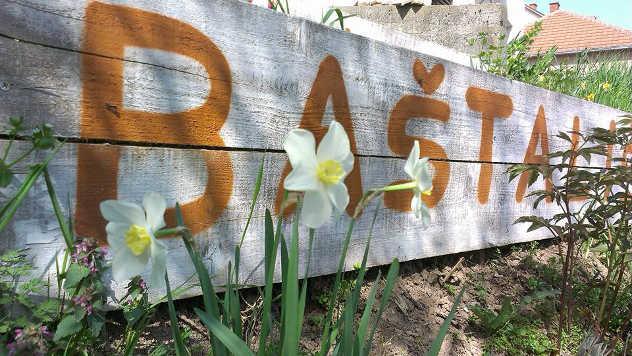
Baštalište is an organic community garden initiative located in the town of Slanci, some 20 minutes from the city centre of Belgrade (Ref. 3). It is one of the first initiatives of its kind in Serbia, emerging after organizations such as WWOOF Serbia and the Belgrade Flower Festival, along with activists and citizens, united with the goal of growing vegetables for their own needs. Additionally, they aimed to highlight the numerous neglected and abandoned urban spaces in the city that could be repurposed in this manner (Ref.1). Even though more and more people would like to join Baštalište, the community has been struggling to grow beyond their original plot of 1800 m2, shared between some 30 people of mixed demographics (Ref. 3). They have turned to the municipality to provide more such spaces for urban community gardening but their appeals bear little success (Ref. 2,3). Despite their spatial constraints, the initiative remains open to anyone who would like to visit and help while being financed by membership fees (Ref. 1,2,3). The initiative hopes to eventually scale this type of activity, drawing inspiration from the example of Zagreb, where over 2,000 garden communities were established within 2.5 years after the city decided to repurpose its neglected areas (Ref. 2).

Overview
Nature-based solution
- Community gardens and allotments
- Community gardens
Key challenges
- Green space, habitats and biodiversity (SDG 15)
- Green space creation and/or management
- Health and well-being (SDG 3)
- Enabling opportunities for physical activity
- Improving physical health
- Social justice, cohesion and equity (SDG 10)
- Social interaction
- Environmental education
- Sense of community and community engagement
- Sustainable consumption and production (SDG 12)
- Sustainable production
- Food scarcity / security
Principal problems in Functional Urban Area (FUA)
- Land use and Socio-economic change
- Unequal availability and access to public green spaces
- Health, Well-being and Social cohesion
- Disconnection from nature
- Other
Key priorities
Focus
Project objectives
Implementation activities
Main beneficiaries
- Public sector institution (e.g. school or hospital)
- Citizens or community groups
- Food producers and cultivators (i.e. farmers, gardeners)
- Young people and children
Governance
Management set-up
- Led by non-government actors
Type of initiating organisation
- Non-government organisation/civil society
- Citizens or community group
Participatory approaches/ community involvement
- Dissemination of information and education
- Joint implementation (e.g. tree planting)
- Co-management/Joint management
Details on the roles of the organisations involved in the project
Project implemented in response to ...
Type of enablers
Financing
Total cost
Source(s) of funding
- Private funding by citizens
Type of funding
- Membership or entrance fees
- Other funding types are unknown
Non-financial contribution
- Provision of goods
- Provision of labour
- Provision of expertise
- Citizens (e.g. volunteering)
Impacts and Monitoring
Environmental impacts
- Green space and habitat
- Increased green space area
- Achieved increased green space area
- Increased number of species present
- Achieved increased number of species present
- Restoration of derelict areas
- Achieved restoration of derelict areas
Economic impacts
- Generation of other type of work opportunities (e.g. voluntary, work for rehabilitation)
- Achieved generation of other type of work opportunities (e.g. voluntary, work for rehabilitation)
- Increase in agricultural production (for profit or not)
- Achieved increase in agricultural production (for profit or not)
- Other
Socio-cultural impacts
- Social justice and cohesion
- Improved social cohesion
- Achieved improved social cohesion
- Improved liveability
- Achieved improved liveability
- Improved access to urban green space
- Achieved improved access to urban green space
- Increased visibility and opportunity for marginalised groups or indigenous peoples
- Achieved increased visibility and opportunity for marginalised groups or indigenous peoples
- Increased opportunities for social interaction
- Achieved increased opportunities for social interaction
- Increased involvement of locals in the management of green spaces
- Achieved increased involvement of locals in the management of green spaces
- Increased access to healthy/affordable food
- Achieved increased access to healthy/affordable food
- Increased sustainability of agriculture practices
- Achieved increased sustainability of agriculture practices
- Health and wellbeing
- Gain in activities for recreation and exercise
- Achieved gain in activities for recreation and exercise
- Cultural heritage and sense of place
- Improvement in people’s connection to nature
- Achieved improvement in people’s connection to nature
- Education
- Increased knowledge of locals about local nature
- Achieved increased knowledge of locals about local nature
- Increased awareness of NBS and their benefits
- Achieved increased awareness of NBS and their benefits
Type of reported impacts
Presence of formal monitoring system
Presence of indicators used in reporting
Presence of monitoring/ evaluation reports
Availability of a web-based monitoring tool
Potential risks of implementation and trade-offs
References
 Information about this nature-based solution was collected as part of the Naturescapes project funded by the European Union under Grant Agreement No 101084341.