

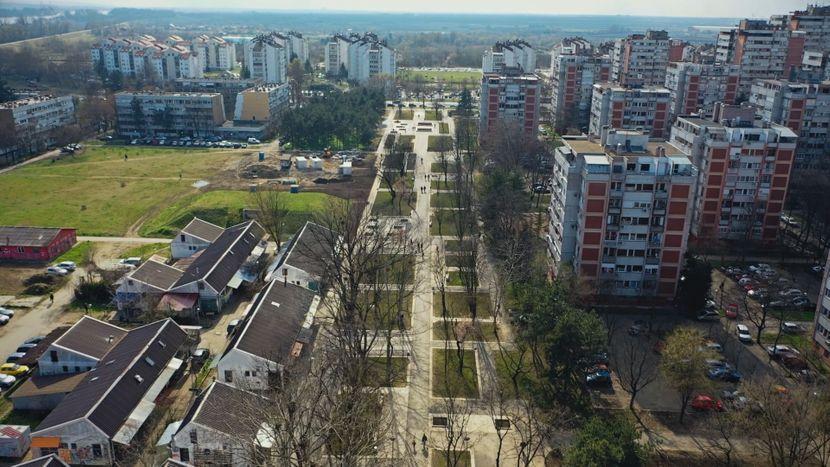
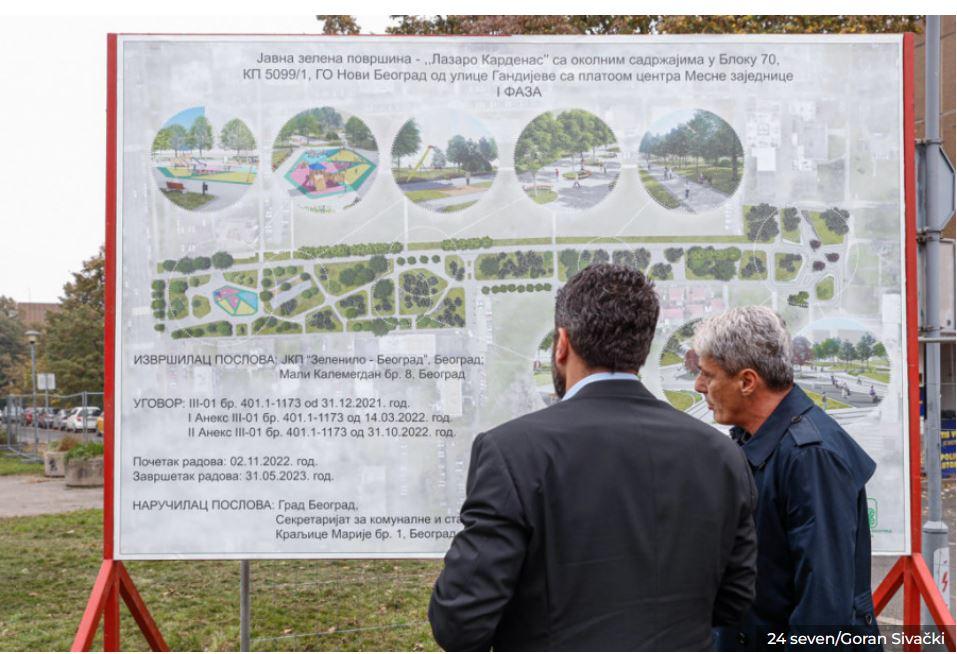
Named after the former Mexican president Lázaro Cárdenas, this green corridor project stretches over 4,5 km throughout one of the most densely populated areas in Belgrade. It was first built in the 1970s, connecting the building blocks 45, 44 and 70 of Novi Beograd, but has deteriorated since then (Ref. 4,9). Given the fact that close to 40.000 people live in the area which its highly vulnerable to climate change, action was taken to fully reconstruct the corridor for the benefit of local and surrounding residents (Ref. 3,4). The project was implemented in three phases, according to the three blocks adjacent to the construction site starting in 2019. During the third implementation phase in 2022, however, major delays occurred due to disagreements with the local neighbourhood association "Common Action Block 70 and 70a", which demanded to be taken into consideration in the project's design (Ref. 2,5). Despite some cooperation between the responsible authority (Greenery Belgrade) and the association, demands could not be met (Ref. 5). In the end, the project was carried out as originally planned by the authorities, with a delay of approximately one year. Ultimately, the green corridor provides ample amenities for sports (bicycle lanes, basketball courts, playgrounds, etc.) and recreational activities (benches, chess area) as well as low-barrier infrastructure for all age groups (Ref. 9). The project was initiated by President Aleksandar Vučić and supported by the current mayor of Belgrade, Šapić, who both have roots in the district (Ref. 4,6).
Overview
Nature-based solution
- Parks and urban forests
- Green corridors and green belts
Key challenges
- Climate action for adaptation, resilience and mitigation (SDG 13)
- Climate change adaptation
- Green space, habitats and biodiversity (SDG 15)
- Green space creation and/or management
- Regeneration, land-use and urban development
- Promote natural styles of landscape design for urban development
- Health and well-being (SDG 3)
- Creation of opportunities for recreation
- Enabling opportunities for physical activity
- Improving physical health
- Social justice, cohesion and equity (SDG 10)
- Social interaction
- Sense of community and community engagement
Principal problems in Functional Urban Area (FUA)
- Climate-Related Hazards
- Heat stress & Extreme temperatures
- Health, Well-being and Social cohesion
- Inadequate access to recreational opportunities
- Poor community engagement
Key priorities
Focus
Project objectives
Implementation activities
Climate-focused activities
Climate change adaptation:
- Increase urban vegetation cover to reduce urban heat island effect
Specification of climate or environmentally vulnerable communities
Main beneficiaries
- Citizens or community groups
- Young people and children
- Marginalized groups: Children, young people or youth groups , Elderly people, People with functional diversities
Governance
Management set-up
- Government-led
Type of initiating organisation
- National government
- Local government/municipality
Participatory approaches/ community involvement
- Dissemination of information and education
- Consultation (e.g. workshop, surveys, community meetings, town halls)
- Joint implementation (e.g. tree planting)
- Co-management/Joint management
- Other
Details on the roles of the organisations involved in the project
Project implemented in response to ...
Type of enablers
Financing
Total cost
Source(s) of funding
- Public local authority budget
- Public national budget
Type of funding
- Earmarked public budget
Non-financial contribution
- Provision of goods
- Provision of labour
- Citizens (e.g. volunteering)
Impacts and Monitoring
Environmental impacts
- Climate change
- Lowered local temperature
- Expected lowered local temperature
- Green space and habitat
- Increased green space area
- Achieved increased green space area
- Increased ecological connectivity across regeneration sites and scales
- Achieved increased ecological connectivity across regeneration sites and scales
Economic impacts
- Increased property prices
- Expected increased property prices
Socio-cultural impacts
- Social justice and cohesion
- Improved liveability
- Achieved improved liveability
- Improved access to urban green space
- Achieved improved access to urban green space
- Increased involvement of locals in the management of green spaces
- Achieved increased involvement of locals in the management of green spaces
- Health and wellbeing
- Gain in activities for recreation and exercise
- Achieved gain in activities for recreation and exercise
- Improved physical health
- Expected improved physical health
- Cultural heritage and sense of place
- Protection of historic and cultural landscape / infrastructure
- Expected protection of historic and cultural landscape / infrastructure
Type of reported impacts
Presence of formal monitoring system
Presence of indicators used in reporting
Presence of monitoring/ evaluation reports
Availability of a web-based monitoring tool
Potential risks of implementation and trade-offs
References
 Information about this nature-based solution was collected as part of the Naturescapes project funded by the European Union under Grant Agreement No 101084341.