

Last updated: October 2021
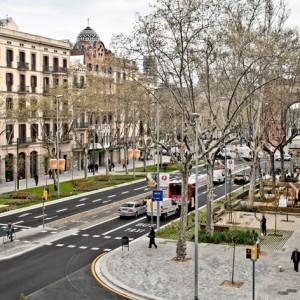
The Barcelona Green Infrastructure and Biodiversity Plan 2020 includes the development of several urban green corridors to increase ecological and social connectivity within the city. The green corridor of Passeig de Sant Joan is one of the first of these corridors implemented. The project consisted of the renovation of the promenade through tree and shrub planting and permeable green pavement installation, creating a green boulevard that benefits pedestrians and extend the urban green spaces, which gave new life to the neighborhood and allowed the expansion of small businesses and tourism (Ref 1).
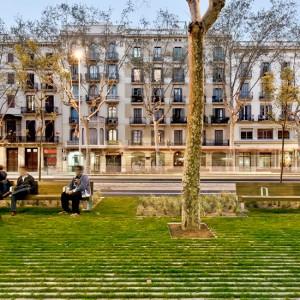
Passeig Sant Joan
http://landezine.com/index.php/2012/07/passeig-de-st-joan-boulevard-by-lola-domenech/
Overview
Nature-based solution
- Grey infrastructure featuring greens
- Alley or street trees and other street vegetation
- Parks and urban forests
- Green corridors and green belts
- Green areas for water management
- Sustainable urban drainage systems
- Other
Key challenges
- Water management (SDG 6)
- Flood protection
- Green space, habitats and biodiversity (SDG 15)
- Green space creation and/or management
- Environmental quality
- Soil quality improvement
- Regeneration, land-use and urban development
- Regulation of built environment
- Promote natural styles of landscape design for urban development
- Social justice, cohesion and equity (SDG 10)
- Social interaction
- Health and well-being (SDG 3)
- Enabling opportunities for physical activity
- Improving mental health
- Improving physical health
- Creation of opportunities for recreation
- Economic development and employment (SDG 8)
- Tourism support
- Cultural heritage and cultural diversity
- Protection of historic and cultural landscape/infrastructure
Focus
Creation of new green areas, Maintenance and management of urban nature, Improved governance of green or blue areas
Project objectives
The new remodelling proposal sets two basic objectives: to give priority to the pedestrian use of the boulevard and turn it into a new urban green zone extending right up to Ciutadella park (Ref. 1). The reduction of the traffic rails, the living zones under the woodland and the segregation of the bicycle rail are key aspects of an urban remodelling that prioritizes the pedestrian use without resigning to functionality. (Ref. 2) The project explicitly states the creation of a green corridor in the urban area of Barcelona as the primary goal (also a major tourist hub and source of economic income for the city) (Ref 1, 2 and 3).
- The incorporation of local shrubs to this tree-lined zone will contribute to enriching subsoil biodiversity. (Ref 1)
Implementation activities
The project was divided into two major phases: one focusing on the development of a larger pedestrian path and one focused on the planting of new rows of trees and the preservation of some local ones that are around 100 years old (Ref 1, 2 and 3). The project explicitly states the creation of a green corridor in the urban area of Barcelona as a primary goal (Ref 1, 2 and 3). It is a fundamental premise of the project to improve Paseo de St Joan as new green urban and sustainable corridor as far as Parque de la Ciutadella. For this reason, two new alignments of trees join on both sides of the existing woodland, shaping on this way an area of natural shadow that will take in the lounges, infantile games and bars. (Ref 2).
In order to achieve these objectives the project has adopted three fundamental urban planning criteria:
1. to guarantee the continuity of the section along the length of the boulevard. Despite the fact that this part of the boulevard currently consists of 3 differentiated sections the remodelling intends to create a new longitudinal section making it uniform along its entire length. The new section is symmetrical and extends the width of the current pavements from 12.5m to 17m, maintaining the century-old trees and accompanying them with two new rows of trees. The layout’s continuity is absolutely essential in order to ensure functional clarity along the entire length of the boulevard.
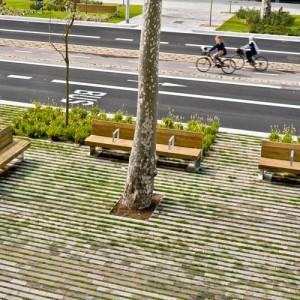
2. to adapt the urban space to different uses. The new section must cater to the different uses of this urban space whilst enabling them to coexist harmoniously. The 17m of pavement have been organised in such a way that 6m are allocated to a pedestrian pavement whilst the remaining 11m under the rows of trees are for recreational uses (benches, children’s play areas and bar terraces). Previous road traffic surveys showed that the original road was too large. So it was possible to reduce the space allocated to traffic and turn it into a pacified transit zone. As part of the new layout, the two-way 4m bicycle lane is physically segregated, protected and signposted, located in the middle of the road. The key tenets of the new proposal are to reduce the number of traffic lanes, create leisure zones under the trees and segregate the bicycle lane.
3. to promote the passeig de St Joan as a new and sustainable urban green zone. Passeig de Sant Joan, which, with its prolongation via the Passeig de Lluís Companys reaches right up to Ciutadella park has been projected as the city’s new green zone. In order to achieve this, two new rows of trees will be planted on both sides of the existing century old trees to create an area of natural shade that will accommodate the new recreational zones, children’s playgrounds and bar terraces. In order to guarantee the sustainability of this new layout we need to ensure proper drainage of the subsoil and take on the challenge of incorporating a mixed pavement system in the tree-lined zone. The treatment of the soil with mixed pavements and the automatic watering system that uses phreatic water are key to ensuring substrata drainage that will guarantee the survival of the vegetation. The incorporation of local shrubs to this tree lined zone will contribute to enriching subsoil biodiversity. The treatment of the pavements is closely linked to the uses of the new street: on the pedestrian section the pavement is made of “panot” paving slabs (typical ensanche paving) whereas in the recreational zones a new prefabricated pavement with draining joints to prevent flooding will be laid down (Ref 1).
Main beneficiaries
- Local government/Municipality
- Private sector/Corporate/Company
- Citizens or community groups
- Young people and children
Governance
Management set-up
- Co-governance with government and non-government actors
Type of initiating organisation
- Local government/municipality
Participatory approaches/ community involvement
- Dissemination of information and education
- Citizen oversight (e.g. boards, advisory)
Details on the roles of the organisations involved in the project
Landscape Architecture: Lola Domènech, architect
Project collaborators: Teresa Galí agronom engeneer / Cimex-engineer
Development company: Proeixample S.A.-(city council-barcelona)
Coordination project: Proeixample S.A (Ref 1).
The Barcelona Green Infrastructure and Biodiversity Plan 2020 (and this specific NBS) is being implemented as a large cooperation between the City of Barcelona, the local citizen council and private companies (Ref 4).
The project is part of the application phase Barcelona is implementing in light of the The EU Biodiversity Strategy 2020 (Ref 6) under the city's Barcelona Green Infrastructure and Biodiversity Plan 2020 (Ref 4).
Project implemented in response to ...
... an EU policy or strategy?
Yes
(The project is part of the application phase Barcelona is implementing in light of the The EU Biodiversity Strategy 2020 (Ref 6). )
... a national policy or strategy?
Unknown
... a local policy or strategy?
Yes
(This NBS is one of the several natural interventions under the Barcelona Green Infrastructure and Biodiversity Plan 2020 (Ref 4). )
Financing
Total cost
More than €4,000,000
Source(s) of funding
- Unknown
Type of funding
- Unknown
Non-financial contribution
Unknown
Impacts and Monitoring
Environmental impacts
- Climate change
- Reduced emissions
- Strengthened capacity to address climate hazards/natural disasters
- Environmental quality
- Improved soil quality
- Water management and blue areas
- Improved water quality
- Increased protection against flooding
- Improved stormwater management
- Green space and habitat
- Increased green space area
- Increased conversion of degraded land or soil
- Reduced biodiversity loss
- Increased number of species present
- Increased ecological connectivity across regeneration sites and scales
- Other
Economic impacts
- More sustainable tourism
- Stimulate development in deprived areas
- Attraction of business and investment
Socio-cultural impacts
- Social justice and cohesion
- Fair distribution of social, environmental and economic benefits of the NBS project
- Improved liveability
- Improved access to urban green space
- Increased opportunities for social interaction
- Health and wellbeing
- Improved physical health
- Improved mental health
- Gain in activities for recreation and exercise
- Cultural heritage and sense of place
- Improvement in people’s connection to nature
- Protection of natural heritage
- Protection of historic and cultural landscape / infrastructure
- Increased appreciation for natural spaces
- Other
Type of reported impacts
Expected impacts, Achieved impacts
Presence of formal monitoring system
Unknown
Presence of indicators used in reporting
No evidence in public records
Presence of monitoring/ evaluation reports
No evidence in public records
Availability of a web-based monitoring tool
Yes
References
1. Landscape Architecture Platform (no date).
Passeig De St Joan Boulevard. Available at: Source link (Accessed: July 17, 2020)
2. Phase two: Source link (website not available in 2020)
3. Hicarquitectura (no date). "Lola Doménech: Remodelación del Passeig Sant Joan". Available at: Source link (Accessed: July 17, 2020)
4. Ajuntament de Barcelona (2013). Barcelona Green Infrastructure and Biodiversity Plan 2020. Available at: Source link (Accessed: July 17, 2020)
5. Ajuntament de Barcelona (2013). Greenery and Biodiversity Plan for 2012-2020. Available at: Source link (Accessed: July 17, 2020)
6. European Commission (2020). The EU Biodiversity Strategy 2020: Bringing nature back into our lives. Available at: Source link (Accessed: July 17, 2020)
7. Méndez, I. (2017). "¿Qué tiene el Passeig de Sant Joan que enamora?". APROTECNIC Group. Available at: Source link (Accessed: July 17, 2020)
8. SmartIdeas (2018). "Barcelona. Remodelación Passeig Sant Joan". BreincoSmartBlog. Available at: Source link (Accessed: July 17, 2020)
9. Yávar, J. (2014). "Paisaje y Arquitectura: Remodelación del Paseo de St Joan, un nuevo corredor verde urbano por Lola Domènech". Available at: Source link (Accessed: July 17, 2020)
Passeig De St Joan Boulevard. Available at: Source link (Accessed: July 17, 2020)
2. Phase two: Source link (website not available in 2020)
3. Hicarquitectura (no date). "Lola Doménech: Remodelación del Passeig Sant Joan". Available at: Source link (Accessed: July 17, 2020)
4. Ajuntament de Barcelona (2013). Barcelona Green Infrastructure and Biodiversity Plan 2020. Available at: Source link (Accessed: July 17, 2020)
5. Ajuntament de Barcelona (2013). Greenery and Biodiversity Plan for 2012-2020. Available at: Source link (Accessed: July 17, 2020)
6. European Commission (2020). The EU Biodiversity Strategy 2020: Bringing nature back into our lives. Available at: Source link (Accessed: July 17, 2020)
7. Méndez, I. (2017). "¿Qué tiene el Passeig de Sant Joan que enamora?". APROTECNIC Group. Available at: Source link (Accessed: July 17, 2020)
8. SmartIdeas (2018). "Barcelona. Remodelación Passeig Sant Joan". BreincoSmartBlog. Available at: Source link (Accessed: July 17, 2020)
9. Yávar, J. (2014). "Paisaje y Arquitectura: Remodelación del Paseo de St Joan, un nuevo corredor verde urbano por Lola Domènech". Available at: Source link (Accessed: July 17, 2020)
Passeig Sant Joan
http://landezine.com/index.php/2012/07/passeig-de-st-joan-boulevard-by-lola-domenech/
Passeig Sant Joan
http://landezine.com/index.php/2012/07/passeig-de-st-joan-boulevard-by-lola-domenech/

Passeig Sant Joan
http://landezine.com/index.php/2012/07/passeig-de-st-joan-boulevard-by-lola-domenech/