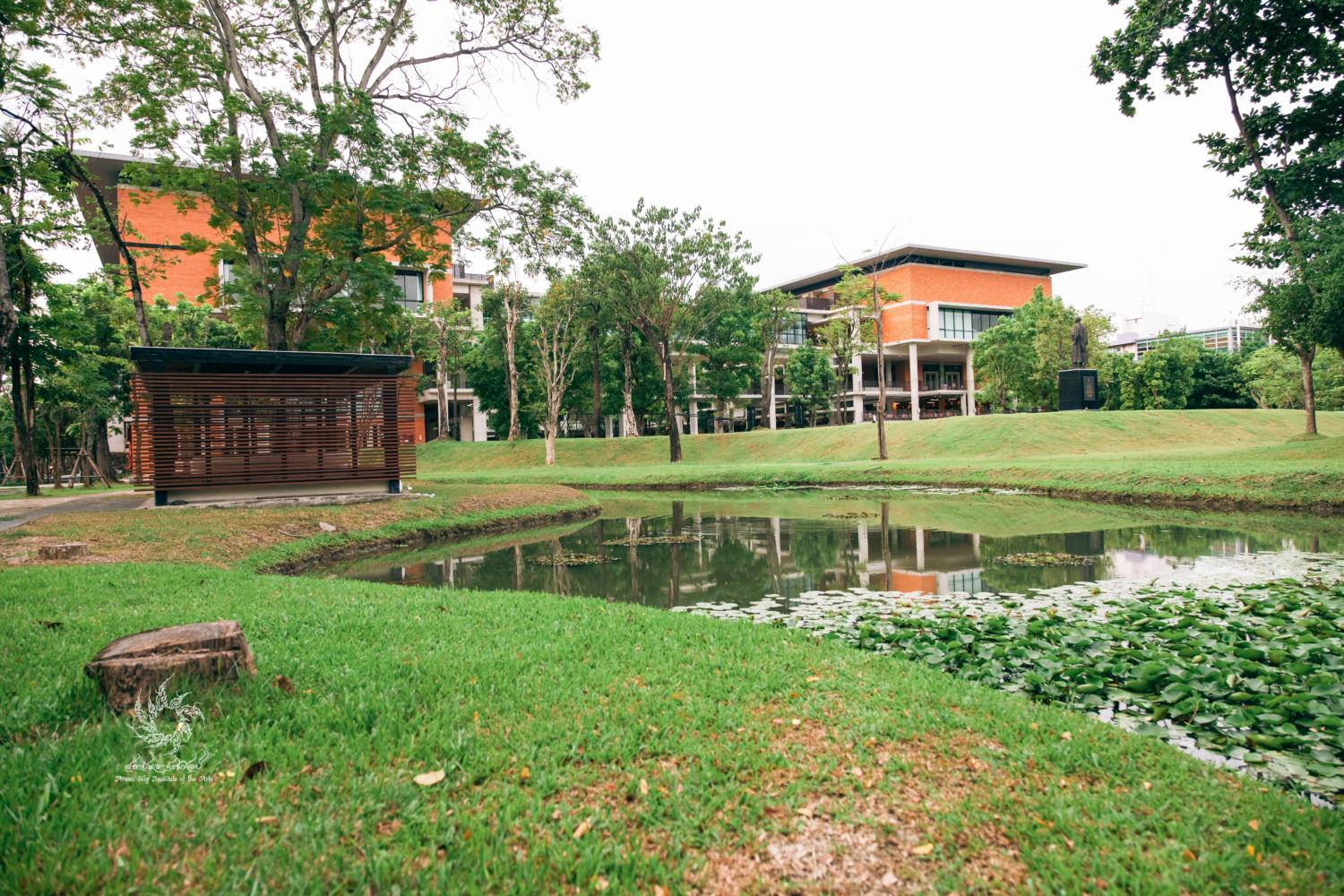
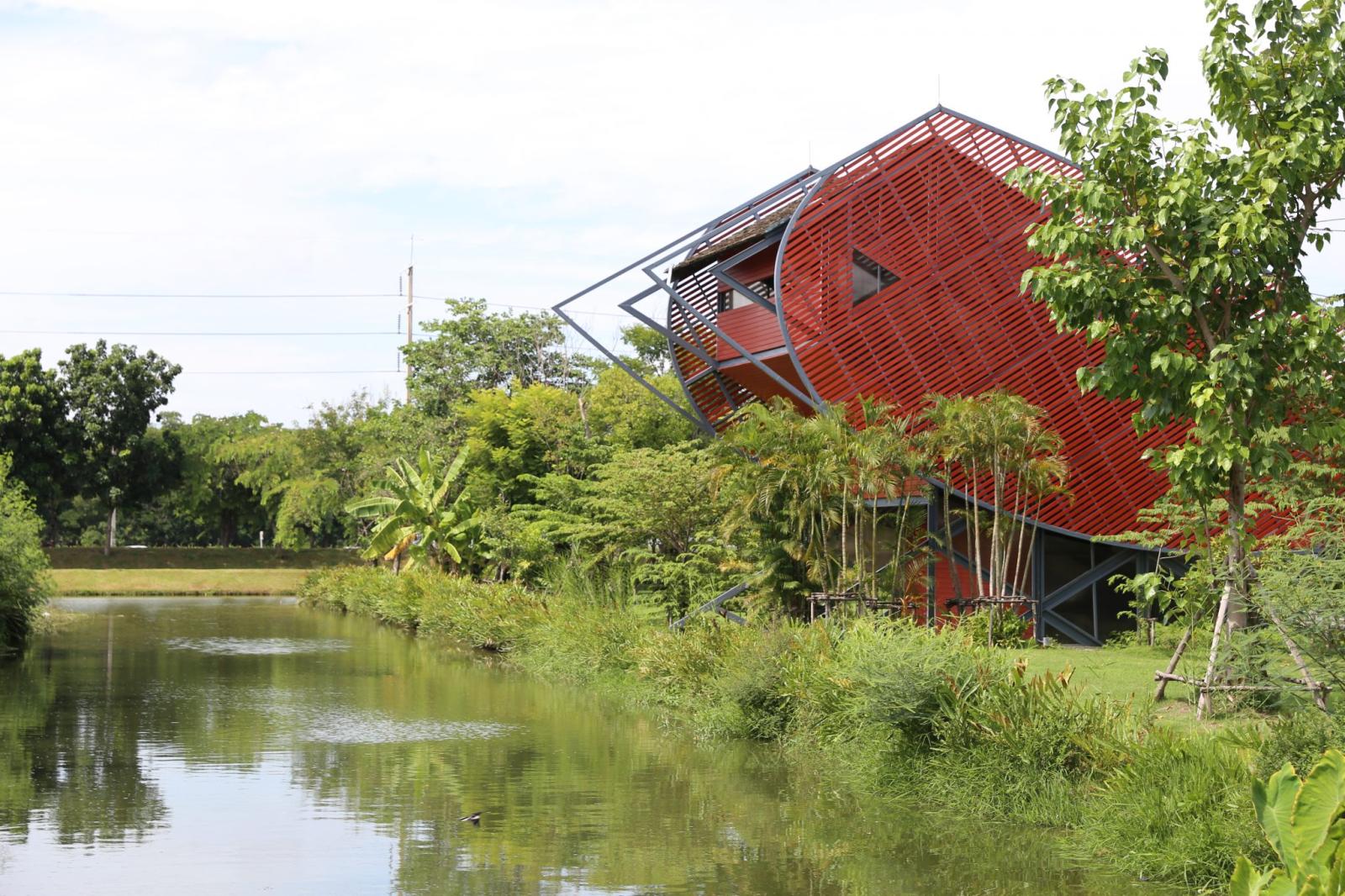
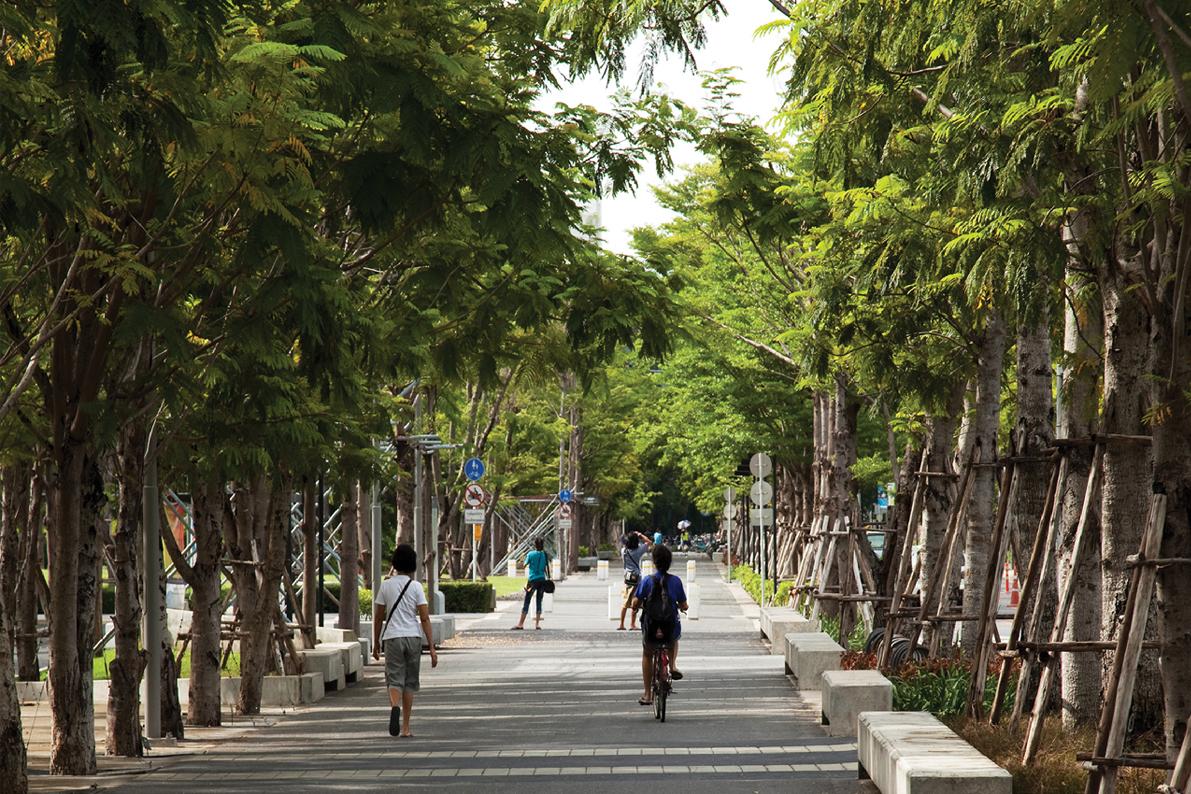
In 2008, Mahidol University in Thailand announced its revised five-year Green Campus master plan titled 'A Promised Place to Live and Learn with Nature' for its main Salaya Campus. The scheme aimed to promote a green conscience and lifestyle for its students and faculty through sustainable campus developments that consider social and environmental aspects. The university's objectives were to achieve energy conservation, environmental sustainability, and social cohesion and well-being. The main features of the master plan included the creation and maintenance of green open spaces covering at least 70% of the campus premises, optimization of land use, transformation of infrastructure to encourage cycling, creation of outdoor learning, recreational and research areas, and enhancement of local biodiversity. The master plan also covered guidelines and targets for energy consumption, waste, and water management in the campus buildings. The Siri Ruckhachati Nature Park, the university's arboretum, was also redesigned with green and blue areas playing a role in flood management. Following the 'Green Campus' master plan, Mahidol University developed its existing mission further and became an 'Eco University' in 2012 and a 'Sustainable University' in 2021. These two missions focus primarily on reducing energy consumption and waste management. (Ref.1,2,3,12)
Overview
Nature-based solution
- Blue infrastructure
- Lakes/ponds
- In-land wetlands, peatlands, swamps, and moors
- Community gardens and allotments
- Community gardens
- Horticulture
- Green areas for water management
- Swales and filter strips
- Grey infrastructure featuring greens
- Alley or street trees and other street vegetation
- Riverbank/Lakeside greens
- Institutional green space
- Nature on buildings (external)
- Green roofs
- Green walls or facades
- Parks and urban forests
- Pocket parks/neighbourhood green spaces
- Botanical gardens
- Green corridors and green belts
Key challenges
- Climate action for adaptation, resilience and mitigation (SDG 13)
- Climate change mitigation
- Green space, habitats and biodiversity (SDG 15)
- Habitat and biodiversity restoration
- Green space creation and/or management
- Regeneration, land-use and urban development
- Regulation of built environment
- Promote natural styles of landscape design for urban development
- Water management (SDG 6)
- Flood protection
- Stormwater and rainfall management and storage
- Improvements to water quality
- Health and well-being (SDG 3)
- Enabling opportunities for physical activity
- Creation of opportunities for recreation
- Social justice, cohesion and equity (SDG 10)
- Social interaction
- Environmental education
- Economic development and employment (SDG 8)
- Economic development: agriculture
- Employment/job creation
- Sustainable consumption and production (SDG 12)
- Sustainable production
Focus
Project objectives
Implementation activities
Climate-focused activities
Climate change mitigation:
- Implement solutions to help reducing energy consumption or support the use of sustainable energy resources
- Invest in public transport/bicycle infrastructure as a means to prevent car use
- Raise public awareness of behaviours, lifestyle and cultural changes with mitigation potential
Biodiversity conservation or restoration-focused activities
Biodiversity conservation:
- Protect and enhance urban habitats
- Preserve and strengthen existing habitats and ecosystems
- Reduce negative impacts and avoid the alteration/damage of ecosystem
- Protect species
- Undertake specific measures to protect native species
- Means for conservation governance
- Manage biological resources for conservation and sustainable use
- Raise public awareness
- Create and use scientific knowledge for conservation
Biodiversity restoration:
- Rehabilitate and restore damaged or destroyed ecosystems
- Restore native species
Main beneficiaries
- Researchers/University
- Citizens or community groups
- Food producers and cultivators (i.e. farmers, gardeners)
Governance
Management set-up
- Led by non-government actors
Type of initiating organisation
- Researchers/university
Participatory approaches/ community involvement
- Co-planning (e.g. stakeholder workshops, focus groups, participatory mapping)
- Dissemination of information and education
- Consultation (e.g. workshop, surveys, community meetings, town halls)
Details on the roles of the organisations involved in the project
Project implemented in response to ...
Financing
Total cost
Source(s) of funding
- Research organisation / University
Type of funding
- Direct funding (grants, subsidies, or self-financed projects by private entities)
Non-financial contribution
Impacts and Monitoring
Environmental impacts
- Climate change
- Reduced emissions
- Environmental quality
- Improved waste management
- Improved soil quality
- Water management and blue areas
- Improved water quality
- Increased protection against flooding
- Improved stormwater management
- Enhanced protection and restoration of freshwater ecosystems
- Green space and habitat
- Promotion of naturalistic styles of landscape design for urban development
- Increased green space area
- Increased conservation or restoration of ecosystems
- Increased conversion of degraded land or soil
- Restoration of derelict areas
Economic impacts
- Increase in agricultural production (for profit or not)
- Generation of income from NBS
Socio-cultural impacts
- Social justice and cohesion
- Improved liveability
- Improved access to urban green space
- Increased visibility and opportunity for marginalised groups or indigenous peoples
- Increased opportunities for social interaction
- Increased access to healthy/affordable food
- Increased sustainability of agriculture practices
- Health and wellbeing
- Gain in activities for recreation and exercise
- Cultural heritage and sense of place
- Improvement in people’s connection to nature
- Protection of natural heritage
- Increased appreciation for natural spaces
- Education
- Increased support for education and scientific research
- Increased knowledge of locals about local nature
Type of reported impacts
Presence of formal monitoring system
Presence of indicators used in reporting
Presence of monitoring/ evaluation reports
Availability of a web-based monitoring tool
References
2. Arsomsilp (no date), MASTER PLAN REDEVELOPMENT OF MAHIDOL UNIVERSITY, Available at Source link (Accessed 21-02-2023)
3. Miss U Salaya (2021), เปิดผังแม่บทมหิดลศาลายา, Available at Source link (Accessed 22-02-2023)
4. MU Link (2015), มหิดล Eco University, Available at Source link (Accessed 22-02-2023)
5. Mahidol University (2013), Sustainable Environment at MU, Available at Source link (Accessed 26-02-2023)
6. Mahidol University (no date), The Green Master Plan, Available at Source link (Accessed 26-02-2023)
7. Mahidol University (2018), มหาวิทยาลัยเชิงนิเวศน์ Eco University, Available at Source link (Accessed 26-02-2023)
8. RYT9 (2010), “มหิดล” ประกาศนโยบายสีเขียว Green Campus รับวันสิ่งแวดล้อมโลก ตั้งเป้าสู่มหาวิทยาลัยต้นแบบด้านการอนุรักษ์ฯ อย่างยั่งยืน, Available at Source link (Accessed 26-02-2023)
9. Mahidol University (2013), Mahidol Sustainable University, Available at Source link (Accessed 26-02-2023)
10. Sireeruckhachati Nature Learning Park (no date), Available at Source link (Accessed 26-02-2023)
11. Dailynews (2013), ต้นแบบมหาวิทยาลัยสีเขียว, Available at https://d.Source link (Accessed 26-02-2023)
12. Miss U Salaya(2021), ตอนเสน่หา ศาลายาวันวาน ช่วง"ผู้พลิกประวัติศาสตร์ด้านกายภาพของวิทยาเขตศาลายา, Avaialble at Source link (Accessed 07-04-2023)
13. Ussawarujikulchai, A., Hansuk, P., Peerakiatkhajohn, P. (2015), แนวทางการจัดการขยะให้เหลือศูนย์ภายในมหาวิทยาลัยมหิดล ศาลายา, Journal of Environmental Management, (Online) Volume 7. Available at Source link (Accessed 07-04-2023)
14. Charmondusit, K., Pungpermtrakul, S., and Mahisavariya, B. (2021), A Best Practice of Water Management at Mahidol University, Salaya Campus, Thailand. Journal of Sustainability Perspectives, (Online) Volume 1. Available at Source link (Accessed 07-04-2023)
15. Bangkok Post (2019), Mahidol pioneers green campus model for univeristies, Available at Source link (Accessed 08-04-2023)