

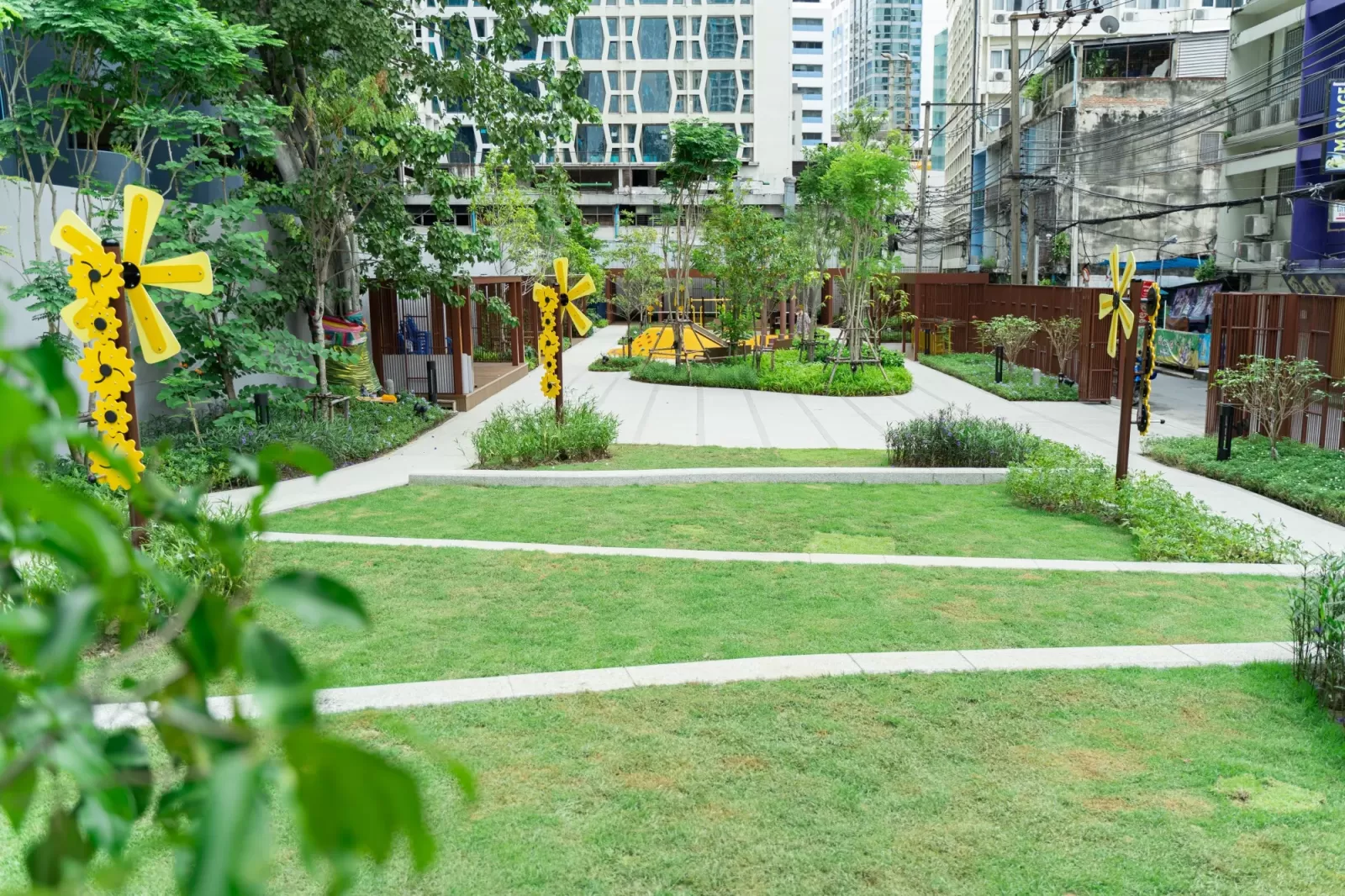
The 'Wat Hua Lamphong Rukkhaniwet' Park was developed by the we!park group, which is part of the ‘Green Bangkok 2030’ project network, aiming to increase the amount of green space in Bangkok. It is a small pocket park in the busy business district of Bangkok, Thailand. The land was abandoned for many years before being donated to the city for public use. We!park applied participatory space development methodology to optimise and tailor the area to its soon-to-be users' needs. As part of this approach, the local community and all the potential users of the park were involved in the form of various surveys, interviews and workshops. Bringing in multiple ideas was a cornerstone of the project planning process - all to create an inclusive garden with elements from everyone in the neighbourhood community - a concept called 'garden next door'. The park has three main parts to accommodate different activities enabling relaxation, and physical activities, and providing space for educational and cultural events. (Ref. 1,2,3,4)
Overview
Nature-based solution
- Community gardens and allotments
- Community gardens
- Parks and urban forests
- Pocket parks/neighbourhood green spaces
Key challenges
- Climate action for adaptation, resilience and mitigation (SDG 13)
- Climate change adaptation
- Green space, habitats and biodiversity (SDG 15)
- Green space creation and/or management
- Regeneration, land-use and urban development
- Promote natural styles of landscape design for urban development
- Water management (SDG 6)
- Stormwater and rainfall management and storage
- Health and well-being (SDG 3)
- Enabling opportunities for physical activity
- Creation of opportunities for recreation
- Inclusive and effective governance (SDG 16)
- Inclusive governance
- Social justice, cohesion and equity (SDG 10)
- Social interaction
Focus
Project objectives
Implementation activities
Climate-focused activities
Climate change adaptation:
- Increase or improve urban vegetation cover to help reduce outdoor temperature
- Create or improve outdoor spaces to help people escape from urban heat
Main beneficiaries
- Citizens or community groups
- Young people and children
Governance
Management set-up
- Co-governance with government and non-government actors
Type of initiating organisation
- Local government/municipality
- Private sector/corporate actor/company
Participatory approaches/ community involvement
- Co-planning (e.g. stakeholder workshops, focus groups, participatory mapping)
- Crowd-sourcing/Crowd-funding/Participatory budget
- Consultation (e.g. workshop, surveys, community meetings, town halls)
- Co-management/Joint management
Details on the roles of the organisations involved in the project
Project implemented in response to ...
Financing
Total cost
Source(s) of funding
- Public local authority budget
- Crowdfunding
Type of funding
- Direct funding (grants, subsidies, or self-financed projects by private entities)
- Donations
Non-financial contribution
Impacts and Monitoring
Environmental impacts
- Environmental quality
- Improved air quality
- Water management and blue areas
- Improved stormwater management
- Green space and habitat
- Promotion of naturalistic styles of landscape design for urban development
- Increased green space area
- Increased conversion of degraded land or soil
- Increased number of species present
- Enhanced support of pollination
Economic impacts
- Other
Socio-cultural impacts
- Social justice and cohesion
- Improved liveability
- Improved access to urban green space
- Increased opportunities for social interaction
- Increased involvement of locals in the management of green spaces
- Increased access to healthy/affordable food
- Health and wellbeing
- Gain in activities for recreation and exercise
- Cultural heritage and sense of place
- Increased sense of place identity, memory and belonging
- Increased awareness of flora and fauna as culturally and historically meaningful
- Education
- Increased knowledge of locals about local nature
Type of reported impacts
Presence of formal monitoring system
Presence of indicators used in reporting
Presence of monitoring/ evaluation reports
Availability of a web-based monitoring tool
References
2. City Cracker (2022), หัวลำโพงรุกขนิเวศน์ ต้นแบบพื้นที่สีเขียวขนาดเล็กที่เกิดขึ้นจริงผ่านการมีส่วนร่วมของทุกภาคส่วน จาก WE!PARK, Available at Source link (Accessed 14-02-2023)
3. The Cloud (2021), we made it, Available at Source link (Accessed 15-02-2023)
4. Mooool (2021), Wat Hua Lamphong Rukkhaniwet Park by Shma Company Limited, Available at Source link (Accessed 16-02-2030)
5. We!park Facebook Page (2021), สวนวัดหัวลำโพงรุกขนิเวศน์, Available at Source link (Accessed 16-02-2023)
6. Bangkok Post (2021), New park open in city, Available at Source link (Accessed 16-02-2023)
7. Bangkokbiz (2021), "สวนวัดหัวลำโพงรุกขนิเวศน์” พื้นที่สีเขียวขนาดเล็กแห่งใหม่ ใจกลางเมือง, Available at Source link (Accessed 19-02-2023)
8. City Cracker (2021), จากที่ดินร้างสู่สวนจิ๋วใหม่ใจกลางเมือง, Available at Source link (Accessed 19-02-2030)
9. The Cloud (2022), ‘สวนวัดหัวลำโพงรุกขนิเวศน์’ พื้นที่สีเขียวเล็ก ๆ กลางเมืองที่ we!park ภูมิใจเสนอ, Available at Source link (Accessed 25-02-2023)
10. The Active (2021), เปลี่ยนที่รกร้างเป็นสวนกลางเมือง : The Active, Available at Source link (Accessed 25-02-2023)
11. The Green Bangkok Project., Available at Source link (Accessed 23-03-2015)


