

Last updated: October 2021
"The main idea of the project is to join the two parks at the end of the intervention (Pedion Areos and Lofos Likavitou) with a green mass that will flow all along the intervention, bringing back the greenery to an area that used to be a green zone in the outside of the old Athens walls.That green corridor is formed by: (1) the existing trees preserved; (2) the new trees added; (3) a continuous floor all along the project with a pattern that is an abstraction from olive tree branches; (4) The artificial activity/bioclimatic trees they create" (Ref 1).
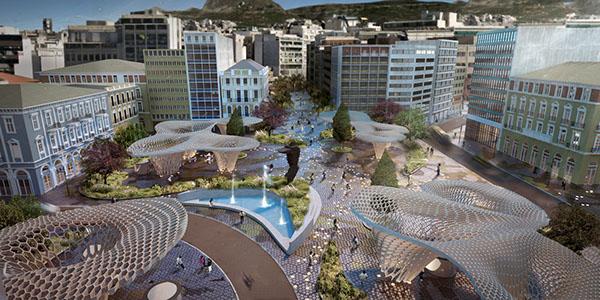
Athens new city centre with green corridor
Source :https://www.behance.net/gallery/7191429/Re-Think-Athens-Towards-a-New-City-Centre-Proposal (Courtesy of ABM Arquitectos)
Overview
Nature-based solution
- Grey infrastructure featuring greens
- Alley or street trees and other street vegetation
- Parks and urban forests
- Green corridors and green belts
Key challenges
- Climate action for adaptation, resilience and mitigation (SDG 13)
- Climate change mitigation
- Green space, habitats and biodiversity (SDG 15)
- Habitat and biodiversity restoration
- Green space creation and/or management
- Environmental quality
- Air quality improvement
- Regeneration, land-use and urban development
- Regulation of built environment
- Promote natural styles of landscape design for urban development
- Health and well-being (SDG 3)
- Improving mental health
- Creation of opportunities for recreation
- Cultural heritage and cultural diversity
- Preservation of natural heritage
- Protection of historic and cultural landscape/infrastructure
Focus
Creation of new green areas, Maintenance and management of urban nature, Monitoring and maintenance of habitats and/or biodiversity
Project objectives
The main idea is to join the two parks at the end of the intervention (Pedion Areos and Lofos Likavitou) with a green mass that will flow all along the intervention, bringing back the greenery to an area that used to be a green zone in the outside of the old Athens walls and creating a green corridor that joins the old Athens with the new Athens (Ref 1). The project also aims at reducing and offsetting carbon emissions in order to achieve a zero-carbon balance, create new spaces for public activities and reduce the harsh climatic conditions of the city (Ref 4).
Implementation activities
As the project is yet to be implemented, followings are the plans of the implementation. Based on the results of a deep analysis of the area the authority has obtained a series of outputs that have guided the activities that they are developing: flows analysis, sun-incidence studies, building uses, full-empty contrasts, demand-offer of activities, existing vegetation mass, existing and foreseen public transportation, transportation and communication nodes, natural-artificial light, etc. Sustainable integration is the key concept at this point. They are planning to preserve the existing trees, add new trees, make a continuous floor all along the project with a pattern that is an abstraction from olive tree branches, and to create an artificial activity/bioclimatic trees. (Ref 1). Native species with lower consumption of natural resources and better adaptation capacity to be planted. More than 2,000 species have been considered until now. Sustainable agricultural practices with efficient irrigation system and use of only organic fertilizer will be one of the key features (Ref 4).
Climate-focused activities
Climate change mitigation:
- Increase green urban nature for carbon storage (wetlands, tree cover)
- Improve carbon sequestration through selection of more adaptable species
- Install vertical or horizontal artificial surfaces that help with carbon storage and cooling
- Invest in public transport/bicycle infrastructure as a means to prevent car use
Biodiversity conservation or restoration-focused activities
Biodiversity restoration:
- Restore species (native, endangered, or unspecified)
Main beneficiaries
- Citizens or community groups
Governance
Management set-up
- Led by non-government actors
Type of initiating organisation
- Local government/municipality
- Private sector/corporate actor/company
- Private foundation/trust
Participatory approaches/ community involvement
- Unknown
Details on the roles of the organisations involved in the project
The project was led by the Onassis Foundation. The organization called for an open competition, the “Re-think Athens” European Architectural Competition for the creation of a new city centre, during an event that took place at the Onassis Cultural Centre. It was funded by the Onassis Foundation and was organized under the auspices and in collaboration with the Ministries of Environment, Energy & Climate Change and of Development, Infrastructure, Transport & Networks, the Attiko Metro S.A., the Region of Attica and the Municipality of Athens (Ref 5).
Project implemented in response to ...
... an EU policy or strategy?
Yes
(Green Infrastructure Strategy (Ref 1), EU Policies for Sustainable Cities’(Ref 3))
... a national policy or strategy?
Yes
(Law 3028/2002, “For the Protection of Antiquities and in general of the Greek
Heritage” (Ref 3))
... a local policy or strategy?
Unknown
Financing
Total cost
More than €4,000,000
Source(s) of funding
- Private Foundation/Trust
Type of funding
- Unknown
Non-financial contribution
Unknown
Impacts and Monitoring
Environmental impacts
- Climate change
- Lowered local temperature
- Enhanced carbon sequestration
- Environmental quality
- Improved air quality
- Green space and habitat
- Increased green space area
- Reduced biodiversity loss
- Increased number of species present
Economic impacts
- Unknown
Socio-cultural impacts
- Social justice and cohesion
- Fair distribution of social, environmental and economic benefits of the NBS project
- Improved liveability
- Improved access to urban green space
- Increased involvement of locals in the management of green spaces
- Health and wellbeing
- Improved mental health
- Cultural heritage and sense of place
- Improvement in people’s connection to nature
Type of reported impacts
Achieved impacts
Presence of formal monitoring system
Unknown
Presence of indicators used in reporting
Yes
Presence of monitoring/ evaluation reports
Yes
Availability of a web-based monitoring tool
No evidence in public records
References
1. RE-THINK ATHENS: TOWARDS A NEW CITY CENTRE. (2013) Behance. Available at: Source link. Accessed on 11th July, 2020.
2. Re-Think Athens Competition Entry / ABM Arquitectos. (2013) Archdaily News article 13th March. Available at: Source link. Accessed on 11th July 2020.
3. Re-think Athens: towards a new city centre. Abstract and report. Second stage of the competition. (no date) available at: Source link. Accessed on 11th July 2020.
4. Re-think Athens competition. (2013) Available at: Source link. Accessed on 7th July, 2020.
5. Re-think Athens competition. (2013) estudioquagliata. Available at: Source link. Accessed on 7th July, 2020.
6. Re-think Athens Project. (no date) Available at: Source link. Accessed on 7th July, 2020.
2. Re-Think Athens Competition Entry / ABM Arquitectos. (2013) Archdaily News article 13th March. Available at: Source link. Accessed on 11th July 2020.
3. Re-think Athens: towards a new city centre. Abstract and report. Second stage of the competition. (no date) available at: Source link. Accessed on 11th July 2020.
4. Re-think Athens competition. (2013) Available at: Source link. Accessed on 7th July, 2020.
5. Re-think Athens competition. (2013) estudioquagliata. Available at: Source link. Accessed on 7th July, 2020.
6. Re-think Athens Project. (no date) Available at: Source link. Accessed on 7th July, 2020.
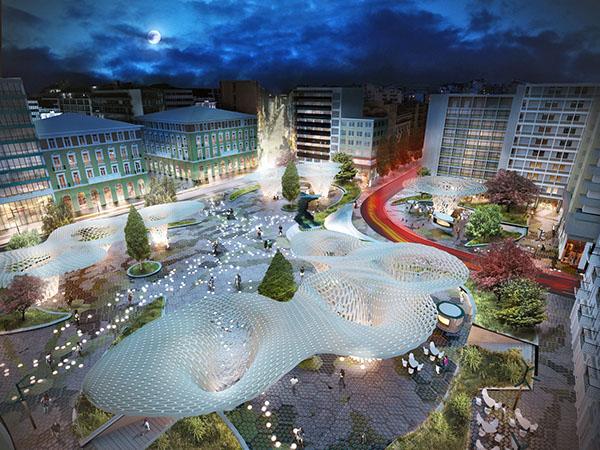
Athens new city centre with green corridor
Source :https://www.behance.net/gallery/7191429/Re-Think-Athens-Towards-a-New-City-Centre-Proposal (Courtesy of ABM Arquitectos)