

Last updated: October 2021
“Frederiksgade gets new and climate-friendly life. Aarhus will be the European City of Culture in 2017, by which time Frederiksgade, running between the river and City Hall, will become an attractive street enhanced by water and greenery in the city centre. The makeover has been possible by innovative, focused collaboration between municipal departments, businesses with widely differing expertise and the owners and tenants of the street itself.” (Ref. 1, 12)
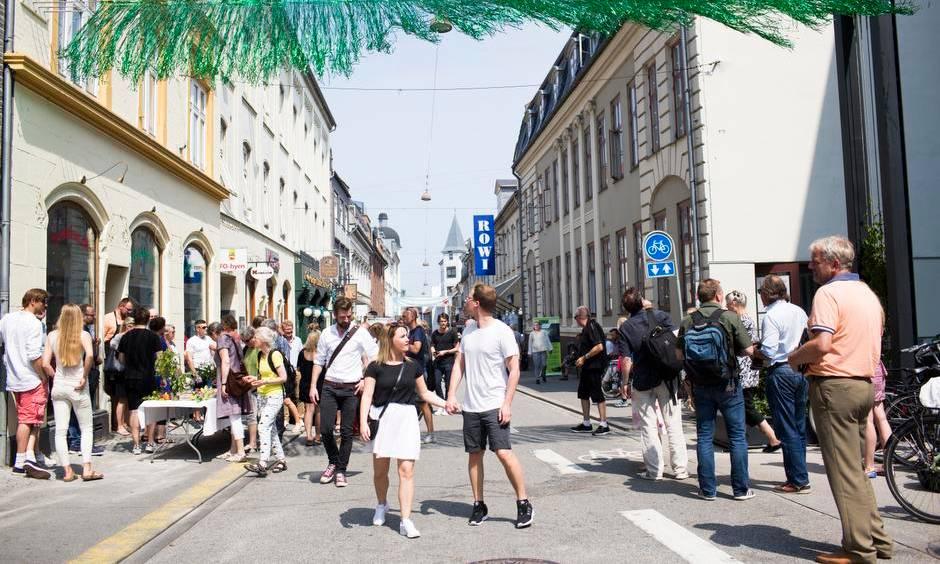
https://jyllands-posten.dk/jpaarhus/ECE7849397/Porten-til-succes-i-Frederiksgade-ligger-i-det-grønne-og-blå/
Overview
Nature-based solution
- Nature on buildings (external)
- Green walls or facades
- Grey infrastructure featuring greens
- Alley or street trees and other street vegetation
- Green areas for water management
- Rain gardens
- Swales and filter strips
- Sustainable urban drainage systems
Key challenges
- Water management (SDG 6)
- Stormwater and rainfall management and storage
- Green space, habitats and biodiversity (SDG 15)
- Green space creation and/or management
- Environmental quality
- Air quality improvement
- Health and well-being (SDG 3)
- Creation of opportunities for recreation
- Economic development and employment (SDG 8)
- Economic development: service sectors
- Real estate development
Focus
Creation of new green areas, Creation of semi-natural blue areas, Maintenance and management of urban nature
Project objectives
"Renovation makes Frederiksgade green and attractive. Sound, light, water and culture. These are the basics of the extensive renovation project for Frederiksgade, already well under way. Better use of rainwater to provide recreational features with room for culture and nature will attract more shoppers and prepare the street for the climate challenges of the future." (Ref. 3) On the outside, Frederiksgade will act as a beacon for the city's ambitions to become CO2-neutral without compromising the comfort of its residents or limiting opportunities for growth for businesses. (Ref. 1)
The vision is that there must be running, visible and audible water in Frederiksgade. Not unmotivated on the street, but in fine canals that give the street a recreational and attractive feel, which is very special in relation to what you find elsewhere in the city, says project manager Tina Fredsted from Aarhus Municipality. (Ref 9)
Frederiksgade must have a green and blue, environmentally friendly profile. It will be a street where facades are greened and the water trickles down the hill towards Aarhus Å. (Ref 10)
Implementation activities
“Preserving the street brought the various factions together in a project entitled as "Det blå-grønne kulturstrøg i Aarhus" (blue/green culture street). The green element consists of flower beds and creeper vegetation on facades and over the street. When it rains, 'blue' water will be channelled through the street in a decorative duct, instead of down into the overloaded sewers.
It involves i.a. an open water canal that runs from the start of the street at the town hall and all the way down to Aarhus Å, various water elements such as green rain beds and interactive water jets that are activated when children move nearby. (Ref 12)
As such, the street solved several municipal requirements via a single project, such as water management, vegetation provision and preparing the city for extreme rainfall expected as a result of climate change. The project also demonstrated that creating growth and boosting revenues in a stagnating area of the city could act as a rallying point.”
(Ref. 1)
Main beneficiaries
- Local government/Municipality
- Private sector/Corporate/Company
- Citizens or community groups
Governance
Management set-up
- Co-governance with government and non-government actors
Type of initiating organisation
- Local government/municipality
Participatory approaches/ community involvement
- Co-planning (e.g. stakeholder workshops, focus groups, participatory mapping)
- Other
Details on the roles of the organisations involved in the project
The City Council adopted a proposal to support the development of Frederiksgade. (Ref. 1)
An 'OPI partnership' between a number of businesses, the City Council and local retailers is developing the Frederiksgade of the future. (Ref. 3)
Municipal partners: Nature and Environment (Climate Secretariat, Green Areas, Aquatic Environment and Agriculture), Planning and Buildings (City Planning Department, Urban Architecture, City Architect), Traffic and Roads, Culture and Citizens Services. (Ref. 2)
Project implemented in response to ...
... an EU policy or strategy?
Yes
(Aarhus City will be the European City of Culture in 2017 and Frederiksgade is also part of City of Culture 2017. (Ref. 1))
... a national policy or strategy?
Unknown
... a local policy or strategy?
Yes
(The City Council adopted a proposal to 'support the development of Frederiksgade' in June 2013. (Ref. 1, 5)
Frederiksgade is also part of City of Culture 2017 (mentioned above). (Ref. 1) )
Financing
Total cost
€50,000 - €100,000
Source(s) of funding
- Unknown
Type of funding
- Direct funding (grants, subsidies, or self-financed projects by private entities)
Non-financial contribution
Unknown
Impacts and Monitoring
Environmental impacts
- Water management and blue areas
- Improved stormwater management
- Green space and habitat
- Promotion of naturalistic styles of landscape design for urban development
- Increased green space area
Economic impacts
- Stimulate development in deprived areas
- Attraction of business and investment
- Generation of income from NBS
Socio-cultural impacts
- Unknown
Type of reported impacts
Expected impacts, Achieved impacts
Presence of formal monitoring system
Yes
Presence of indicators used in reporting
Yes
Presence of monitoring/ evaluation reports
Yes
Availability of a web-based monitoring tool
No evidence in public records
References
Ref. 1. Aarhus Kommune(2016) Frederiksgade gets new and climate-friendly life. Projects. Information obtained: 2017-06-23. [Website not available in 2020]
Ref. 2. Aarhus Kommune (2016) Objectives. Projects. Information obtained: 2017-06-23. [Website not available in 2020]
Ref. 3. Aarhus Kommune (2016) Project: Frederiksgade revived with the climate in mind. Information obtained: 2017-06-23. [Website not available in 2020]
Ref. 4. Aarhus Kommune (n.d.) Aarhus CO2 neutral in 2030 - tackling climate change in ecocity Aarhus. Source: Source link [Accessed on 14 September 2020]
Ref. 5. Aarhus Kommune (2013) Sag 40: Forslag fra S og SFs byrådsgrupper om at støtte Frederiksgades fremtidige udvikling. Information obtained: 2017-06-23. [Website not available in 2020]
Ref. 6. Aarhus Kommune (2013) Frederiksgade skal være blå og grøn. Information obtained: 2017-06-23. [Website not available in 2020]
Ref. 7. Aarhus Kommune (2016) Arkitema. Arkitema Architects. Partnere. Information obtained: 2017-06-23. [Website not available in 2020]
Ref. 8. Fælles Pulje (2014) Ansøgningsskema Fælles Pulje: Det blå-grønne kulturstrøg i Aarhus. Innovation i Aarhus. Source: Source link [Accessed on 14 September 2020]
Ref. 9. Licitationen (2014) Soldrevet pumpe gør aarhusiansk gade blå. Source: Source link [Accessed on 14 September 2020]
Ref. 10. Arhus Stifstidende (2014) Uenighed om redningsplan for Frederiksgade. Source: Source link [Accessed on 14 September 2020]
Ref. 11. Arhus Stifstidende (2014) Frederiksgade kommer op igen. Source: Source link [Accessed on 14 September 2020]
Ref. 12. Jyllands-Posten (2015) Porten til succes i Frederiksgade ligger i det grønne og blå. Source: Source link [Accessed on 14 September 2020]
Ref. 2. Aarhus Kommune (2016) Objectives. Projects. Information obtained: 2017-06-23. [Website not available in 2020]
Ref. 3. Aarhus Kommune (2016) Project: Frederiksgade revived with the climate in mind. Information obtained: 2017-06-23. [Website not available in 2020]
Ref. 4. Aarhus Kommune (n.d.) Aarhus CO2 neutral in 2030 - tackling climate change in ecocity Aarhus. Source: Source link [Accessed on 14 September 2020]
Ref. 5. Aarhus Kommune (2013) Sag 40: Forslag fra S og SFs byrådsgrupper om at støtte Frederiksgades fremtidige udvikling. Information obtained: 2017-06-23. [Website not available in 2020]
Ref. 6. Aarhus Kommune (2013) Frederiksgade skal være blå og grøn. Information obtained: 2017-06-23. [Website not available in 2020]
Ref. 7. Aarhus Kommune (2016) Arkitema. Arkitema Architects. Partnere. Information obtained: 2017-06-23. [Website not available in 2020]
Ref. 8. Fælles Pulje (2014) Ansøgningsskema Fælles Pulje: Det blå-grønne kulturstrøg i Aarhus. Innovation i Aarhus. Source: Source link [Accessed on 14 September 2020]
Ref. 9. Licitationen (2014) Soldrevet pumpe gør aarhusiansk gade blå. Source: Source link [Accessed on 14 September 2020]
Ref. 10. Arhus Stifstidende (2014) Uenighed om redningsplan for Frederiksgade. Source: Source link [Accessed on 14 September 2020]
Ref. 11. Arhus Stifstidende (2014) Frederiksgade kommer op igen. Source: Source link [Accessed on 14 September 2020]
Ref. 12. Jyllands-Posten (2015) Porten til succes i Frederiksgade ligger i det grønne og blå. Source: Source link [Accessed on 14 September 2020]