

Last updated: October 2021
'Blok 54' is a new building on the city island IJburg in Amsterdam, on which a green roof and rain garden were be created in which stormwater can flow from the green roof through a groove with diverse vegetation, reflecting a natural creek. The vegetation with fruit bushes serves as a sensory garden for poly handicapped children and the creek flows into bioswales through which can slowly infiltrate. Blok 54 can thereby be considered an ECOcity-garden. (1,3)
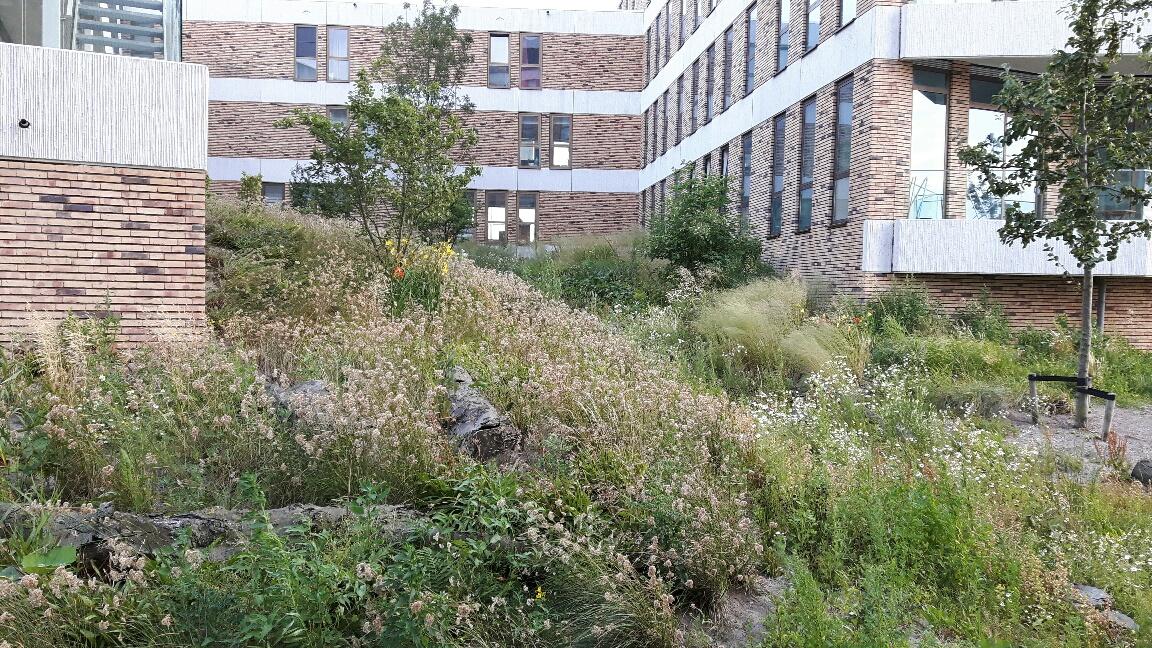
Rain Garden on City Island
Photographer: Annemieke Langendoen (2017), retrieved 08/10/2018 from Marie-José Copal (http://www.hollandsgroenbv.nl )
Overview
Nature-based solution
- Nature on buildings (external)
- Green roofs
- Grey infrastructure featuring greens
- House gardens
- Community gardens and allotments
- Community gardens
- Other
- Green areas for water management
- Rain gardens
- Swales and filter strips
- Sustainable urban drainage systems
Key challenges
- Water management (SDG 6)
- Flood protection
- Stormwater and rainfall management and storage
- Green space, habitats and biodiversity (SDG 15)
- Green space creation and/or management
- Regeneration, land-use and urban development
- Promote natural styles of landscape design for urban development
- Social justice, cohesion and equity (SDG 10)
- Environmental education
- Social cohesion
- Health and well-being (SDG 3)
- Creation of opportunities for recreation
- Sustainable consumption and production (SDG 12)
- Sustainable consumption
- Sustainable production
Focus
Creation of new green areas
Project objectives
1. Maximize stormwater retention in order to make sure that a majority of rainwater does not flow into the sewage system (1,3,5)
2. Increase the flood protection of the building and relieve the central sewage system through the creation of a green roof in combination with the rain garden that operates as a sustainable drainage system (1,3)
3. Promote biodiversity through the creation of habitat for birds and species by means of tree stumps, diverse vegetation and water surface (1,3)
4. Improvement of social cohesion through events around implemented green structures such as an annual harvest festival (1,3)
5. Creation of opportunity for sustainable food production: fruit trees provide fruit such as apples and fruit bushes and plants provide strawberries and berries. (3)
6. Improve the well-being of children with functional diversities: the vegetation along the creek acts as a sensory garden for children in the child care residential inside the building. (1,3)
Implementation activities
- Creation of a green roof with vegetation that buffers storm water. (1,3,5)
- Building of a creek: in which excess water from the green roof can flow down
- Plantation of vegetation along the creek that provides habitat and food for insects and birds (1)
- Installation of bio-swales with flower rich vegetation and tree stumps that provides habitat and helps to slow down the water, which facilitates infiltration of water into the soil (3)
- Plantation of fruit trees and fruit bushes that provide fruits such as apples and berries for human consumption as well as for animal species (1)
- Organisation of the annual harvest festival for inhabitants where they can interact and improve their social cohesion .
(1,3)
- Installation of smaller bio-swales that collect water from the balconies of the houses in the building (3)
- Formation of a rain garden with the combined implementation of the green roof, the vegetation-rich creek and the bio-swales (1)
Main beneficiaries
- Citizens or community groups
- Marginalized groups: Other
Governance
Management set-up
- Co-governance with government and non-government actors
Type of initiating organisation
- Local government/municipality
- Private sector/corporate actor/company
Participatory approaches/ community involvement
- Unknown
Details on the roles of the organisations involved in the project
The municipality of Amsterdam initiated building the Haveneiland Oost (part of the new city island of Amsterdam) and put housing, environmental and ecological standards to buildings on this part of the island. The housing corporation (De Aliantie) initiated building the housing complex 'Blok 54' and assigned a landscape designer to design a rain garden that meets the standards of the municipality. The designers, Hollands Groen BV and Van der Tol BV eventually designed and implemented the NBS (1,2,3,4). The maintenance of the building and garden is the responsibility of the housing corporation (De Alliantie) which is the owner of the housing complex. (2) Inhabitants of the building will be responsible for organizing the harvest festival and the children health care residential (Omega: child care organization specialized in poly disabled children between 3 and 17) is responsible for letting the children enjoy the sensory garden. (3)
Project implemented in response to ...
... an EU policy or strategy?
Unknown
... a national policy or strategy?
Unknown
... a local policy or strategy?
Yes
(The NBS was a reaction to city plan, the Stedenbouwkundig Plan Haveneiland en Rieteiland Oost (Spatial Planning Haveneiland and Rieteiland East) provided by the municipality of Amsterdam for the area of the island on which the building is built which accommodating the NBS (1,4). One of the requirements provided in the city plan is that at least 30% of all roofs should be green roof and that at least 80% of storm water should be retained on the island itself (1,2,4).)
Financing
Total cost
Unknown
Source(s) of funding
- Public local authority budget
- Corporate investment
Type of funding
- Earmarked public budget
- Direct funding (grants, subsidies, or self-financed projects by private entities)
Non-financial contribution
Unknown
Impacts and Monitoring
Environmental impacts
- Water management and blue areas
- Improved stormwater management
- Green space and habitat
- Promotion of naturalistic styles of landscape design for urban development
- Increased green space area
- Increased number of species present
Economic impacts
- Unknown
Socio-cultural impacts
- Social justice and cohesion
- Improved social cohesion
- Increased opportunities for social interaction
- Increased access to healthy/affordable food
- Health and wellbeing
- Gain in activities for recreation and exercise
- Cultural heritage and sense of place
- Increased awareness of flora and fauna as culturally and historically meaningful
- Education
- Increased knowledge of locals about local nature
Type of reported impacts
Expected impacts, Achieved impacts
Presence of formal monitoring system
Unknown
Presence of indicators used in reporting
No evidence in public records
Presence of monitoring/ evaluation reports
No evidence in public records
Availability of a web-based monitoring tool
No
References
1. Amsterdam Rainproof. (2017). Regentuin IJburg Blok 54. Accessed on November 4, 2020, Source link
2. De Aliantie. (n.d.). Blok 54: Prachtig gelegen naast het water. Website not available
3. Hollands Groen. (n.d.). IJburg Blok 54 Amsterdam. Website not available
4. Proectbureau IJburg. (2004). Stedenbouwkundig Plan Haveneiland en Rieteiland Oost. Accessed on November 4, 2020, Source link
5. Amsterdam Rainproof (2015). Van der Tol. Accessed on November 4, 2020, Source link
2. De Aliantie. (n.d.). Blok 54: Prachtig gelegen naast het water. Website not available
3. Hollands Groen. (n.d.). IJburg Blok 54 Amsterdam. Website not available
4. Proectbureau IJburg. (2004). Stedenbouwkundig Plan Haveneiland en Rieteiland Oost. Accessed on November 4, 2020, Source link
5. Amsterdam Rainproof (2015). Van der Tol. Accessed on November 4, 2020, Source link

Rain Garden on City Island
Photographer: Annemieke Langendoen (2017), retrieved 08/10/2018 from Marie-José Copal (http://www.hollandsgroenbv.nl )

Rain Garden on City Island
Photographer: Annemieke Langendoen (2017), retrieved 08/10/2018 from Marie-José Copal (http://www.hollandsgroenbv.nl )

Rain Garden on City Island
Photographer: Annemieke Langendoen (2017), retrieved 08/10/2018 from Marie-José Copal (http://www.hollandsgroenbv.nl )