

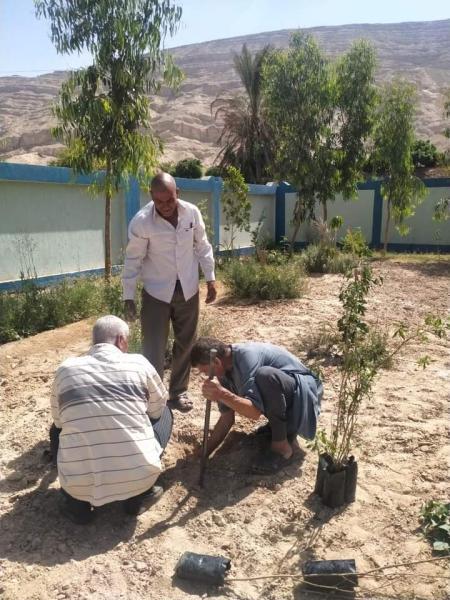
Alexandria is one of the world’s most climate-vulnerable cities, facing serious environmental challenges that threaten its landscape, culture, and livability. The city is grappling with rising sea levels, pollution, extreme fluctuations in temperature, and the intensifying urban heat island effect, all of which are worsened by climate change. The past decade has seen a steady decline in Alexandria’s parks and green areas, a trend that has raised significant concerns among environmentalists and the public. The shrinking green spaces are largely due to rapid urban expansion and the development of commercial projects, which are gradually pushing Alexandria's environmental balance and cultural heritage to the edge. In recognition of these pressing issues, Egypt launched the "100 Million Trees Initiative" in 2022 as part of its Egypt Vision 2030, a national plan for sustainable development. The initiative aims to increase the per capita share of green space throughout the country, with objectives that include improving air quality, enhancing public health, countering the urban heat island effect, and reducing greenhouse gases. The initiative is also focused on improving the beauty and cultural value of Egypt's urban areas, aligning with broader goals to build sustainable and climate-resilient cities. Alexandria, being a coastal city that is both environmentally sensitive and culturally significant, has been a focal point of these efforts. As part of this national campaign, the Governor of Alexandria was tasked with overseeing the enhancement and expansion of green spaces across the city, focusing on both the aesthetics and cultural aspects of the urban landscape. In 2023, these efforts took root in the Al-Muntazah 2 neighborhood, where 596 trees were planted as a contribution to the 100 Million Trees Initiative. This project included the Al-Samad Preparatory and Secondary Schools campus as one of its primary planting sites. (1-5)
Overview
Nature-based solution
- Grey infrastructure featuring greens
- Green playgrounds and school grounds
Key challenges
- Climate action for adaptation, resilience and mitigation (SDG 13)
- Climate change adaptation
- Climate change mitigation
- Environmental quality
- Air quality improvement
- Green space, habitats and biodiversity (SDG 15)
- Green space creation and/or management
- Health and well-being (SDG 3)
- Improving physical health
- Social justice, cohesion and equity (SDG 10)
- Social justice and equity
- Social interaction
Principal problems in Functional Urban Area (FUA)
- Climate-Related Hazards
- Heat stress & Extreme temperatures
- Environmental Degradation
- Air pollution
- Land use and Socio-economic change
- Rapid urbanization
- Health, Well-being and Social cohesion
- Physical health harm (from pollution, wildfire, extreme temperature)
Key priorities
Focus
Project objectives
Implementation activities
Climate-focused activities
Climate change adaptation:
- Increase urban vegetation cover to reduce urban heat island effect
Climate change mitigation:
- Increase the availability of green urban space for carbon storage (street tree cover)
Specification of climate or environmentally vulnerable communities
Main beneficiaries
- Public sector institution (e.g. school or hospital)
- Young people and children
Governance
Management set-up
- Government-led
Type of initiating organisation
- National government
- Local government/municipality
Participatory approaches/ community involvement
- Joint implementation (e.g. tree planting)
- Co-management/Joint management
Details on the roles of the organisations involved in the project
Project implemented in response to ...
Type of enablers
Financing
Total cost
Source(s) of funding
- Public national budget
Type of funding
- Earmarked public budget
Non-financial contribution
- Provision of labour
- Citizens (e.g. volunteering)
Impacts and Monitoring
Environmental impacts
- Climate change
- Lowered local temperature
- Expected lowered local temperature
- Enhanced carbon sequestration
- Expected enhanced carbon sequestration
- Environmental quality
- Improved air quality
- Expected improved air quality
- Green space and habitat
- Increased green space area
- Achieved increased green space area
- Increased number of species present
- Achieved increased number of species present
Economic impacts
- Generation of income from NBS
- Expected generation of income from NBS
Socio-cultural impacts
- Social justice and cohesion
- Increased opportunities for social interaction
- Expected increased opportunities for social interaction
- Health and wellbeing
- Improved physical health
- Expected improved physical health
- Education
- Increased awareness of NBS and their benefits
- Expected increased awareness of NBS and their benefits
Type of reported impacts
Presence of formal monitoring system
Presence of indicators used in reporting
Presence of monitoring/ evaluation reports
Availability of a web-based monitoring tool
Potential risks of implementation and trade-offs
References
 Information about this nature-based solution was collected as part of the Naturescapes project funded by the European Union under Grant Agreement No 101084341.