

Last updated: October 2021
The Garden Janine (formerly called Jardin Nouveau) group is participating in the "Aix en Transition" initiative, which wants to increase food and energy resilience in order to better prepare for the future. This group initiated and supported the establishment of a vegetable garden benefiting homeless people, hosted in the Humanitarian Division of the "Jas de Bouffan" district (Ref. 1). A garden was previously cultivated on the area, but had become dilapidated. In 2019, much of the area was repurposed as an orchard as the vegetable garden was deemed to require too much continual presence/labour (Ref. 6).
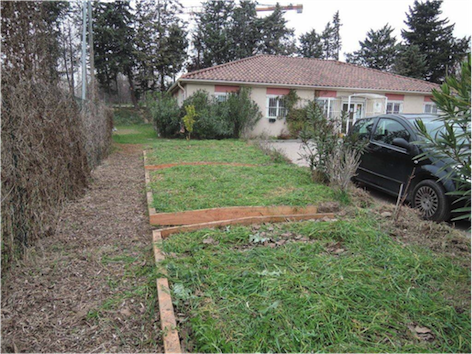
Le Jardin Janine - Community Garden Janine
Source: http://www.paysdaixentransition.org/1639-2/
Overview
Nature-based solution
- Community gardens and allotments
- Community gardens
- Horticulture
Key challenges
- Water management (SDG 6)
- Stormwater and rainfall management and storage
- Improvements to water quality
- Green space, habitats and biodiversity (SDG 15)
- Habitat and biodiversity restoration
- Green space creation and/or management
- Environmental quality
- Soil quality improvement
- Waste management
- Inclusive and effective governance (SDG 16)
- Inclusive governance
- Social justice, cohesion and equity (SDG 10)
- Social justice and equity
- Social cohesion
- Social interaction
- Health and well-being (SDG 3)
- Improving mental health
- Improving physical health
- Creation of opportunities for recreation
- Sustainable consumption and production (SDG 12)
- Sustainable consumption
- Sustainable production
Focus
Maintenance and management of urban nature, Transformation of previously derelict areas
Project objectives
"The New Garden brings together people who are in a precarious situation and others who can and want to help. Homeless people, who live in constraint, find a peaceful space where esteem and trust develop, where solidarity is felt, where a desirable future can take shape." (Ref. 2)
"With its flowers and companion plants, it will also bring beauty and soothing contact with Nature" (Ref. 3, page 2)
"It is a question of improving the ordinary meals served to homeless people welcomed at the Day stop" (Ref. 5).
"Learn by doing, acquire useful knowledge and skills, prepare for the world that comes, find a way to reintegration: all this is possible for those who want to get involved and cultivate at the Jardin Nouveau" (Ref. 2).
Implementation activities
Water management:
"Plot 1 is provided with Drains, buried drainage pipes that evacuate water stormwater towards the stadium without pollution of cultivated soil" (Ref. 4)
Sustainable consumption and production:
"The ethics and methods of Permaculture are expressed in the New Garden: to be attentive to the earth, to the humans, and to make the surplus to the earth and the living. Biodiversity preserved. Zero pesticide, zero herbicide.""The activities are collective. Listening, respect and sharing are common rules and harvests are a time of celebration." (Ref. 2)
"Drip and mulch maintain the fertility conditions of the soil." (Ref. 3, page 5)
"Initially the garden will receive soil amendments from outside: topsoil if needed, manure, compost. Subsequently composting on site will limit the need." (Ref. 4, page 3)
Social justice, cohesion, and equity:
"Twice a year the Garden welcomes visits to other gardens in the Pays d'Aix in transition or other actors in the ESS associative to inspire and make others the desire to do the same." (Ref. 4, page 7)
"Next steps: planting of apple trees and pear trees in espalier, preparation of soil for winter, plan of culture 2017" (Ref. 5)
Biodiversity conservation or restoration-focused activities
Biodiversity restoration:
- Restore species (native, endangered, or unspecified)
- Restore valued species
- Public engagement
Main beneficiaries
- Citizens or community groups
- Marginalized groups: Socio-economically disadvantaged populations (e.g. low-income households, unemployed), Other
Governance
Management set-up
- Co-governance with government and non-government actors
Type of initiating organisation
- Local government/municipality
- Non-government organisation/civil society
Participatory approaches/ community involvement
- Taskforce groups
- Dissemination of information and education
- Consultation (e.g. workshop, surveys, community meetings, town halls)
- Joint implementation (e.g. tree planting)
Details on the roles of the organisations involved in the project
-"The COLLECTIF GERMAIN NOUVEAU" has asked the Pays d'Aix in Transition (NGO who support Permaculture projects) to revive a garden that was once cultivated on these green spaces" (Ref. 3, page 2)
-Reception and Orientation Services (SAO), dependent of the Communal Center for Social Action (CCAS) (a local public institution run by a board of directors chaired by the mayor) is financing the project (Ref. 3, page 2)
Project implemented in response to ...
... an EU policy or strategy?
Unknown
... a national policy or strategy?
Unknown
... a local policy or strategy?
Unknown
Financing
Total cost
Less than €10,000
Source(s) of funding
- Public local authority budget
Type of funding
- Earmarked public budget
Non-financial contribution
Type of non-financial contribution
- Provision of land
- Provision of goods
- Provision of labour
Who provided the non-financial contribution?
- Public authorities (e.g. land, utility services)
- Citizens (e.g. volunteering)
Impacts and Monitoring
Environmental impacts
- Environmental quality
- Improved waste management
- Improved soil quality
- Water management and blue areas
- Improved stormwater management
- Green space and habitat
- Increased green space area
- Increased conversion of degraded land or soil
- Reduced biodiversity loss
- Increased number of species present
Economic impacts
- Increase in agricultural production (for profit or not)
Socio-cultural impacts
- Social justice and cohesion
- Increased visibility and opportunity for marginalised groups or indigenous peoples
- Increased access to healthy/affordable food
- Health and wellbeing
- Improved physical health
- Improved mental health
- Cultural heritage and sense of place
- Improvement in people’s connection to nature
- Increased sense of place identity, memory and belonging
- Increased appreciation for natural spaces
- Education
- Increased knowledge of locals about local nature
- Increased awareness of NBS and their benefits
- Other
Type of reported impacts
Achieved impacts
Presence of formal monitoring system
Yes
Presence of indicators used in reporting
Yes
Presence of monitoring/ evaluation reports
Yes
Availability of a web-based monitoring tool
No evidence in public records
References
1. Pays d'Aix en Transition (2015). "Projet Jardin Nouveau". Source link. Website not available in 2020.
2. Pays d'Aix en Transition (2015). "Charte Du Jardin Nouveau". Available at: Source link (Accessed: Jul 08 2020).
3. Pays d'Aix en Transition (2015). "Jardin Nouveau - Concept d’emploi". Available at: Source link (Accessed: Jul 08 2020).
4. Pays d'Aix en Transition (2015). "Jardin Nouveau - Design". Available at: Source link (Accessed: Jul 08 2020).
5. Pays d'Aix en Transition (2016). "Jardin Janine: un jardin solidaire. Le Jardin Janine, ancien jardin Nouveau". Available at: Source link (Accessed: Jul 08 2020).
6. Pays d'Aix en Transition (2019). "Plantation d’arbres fruitiers au jardin Janine". Available at: Source link (Accessed: Jul 08 2020).
7. Pays d'Aix en Transition (2015). "Jardin Nouveau-Plan de déroulement". Available at: Source link (Accessed Jul 08 2020).
2. Pays d'Aix en Transition (2015). "Charte Du Jardin Nouveau". Available at: Source link (Accessed: Jul 08 2020).
3. Pays d'Aix en Transition (2015). "Jardin Nouveau - Concept d’emploi". Available at: Source link (Accessed: Jul 08 2020).
4. Pays d'Aix en Transition (2015). "Jardin Nouveau - Design". Available at: Source link (Accessed: Jul 08 2020).
5. Pays d'Aix en Transition (2016). "Jardin Janine: un jardin solidaire. Le Jardin Janine, ancien jardin Nouveau". Available at: Source link (Accessed: Jul 08 2020).
6. Pays d'Aix en Transition (2019). "Plantation d’arbres fruitiers au jardin Janine". Available at: Source link (Accessed: Jul 08 2020).
7. Pays d'Aix en Transition (2015). "Jardin Nouveau-Plan de déroulement". Available at: Source link (Accessed Jul 08 2020).